CLL: Intermittent Fasting,
Reducing Carbs, and Detox Bath

Third birthday party fun!

I just wanted to check in because it’s been a while since I’ve made a post, and one of my CLL-buddies just wrote to ask if I’m okay. I am. I am okay. My numbers continue to be stable and I like to coast occasionally. By “coast” I mean that I continue doing whatever is working, and otherwise try to live a normal life. This can be a challenge. I will explain.

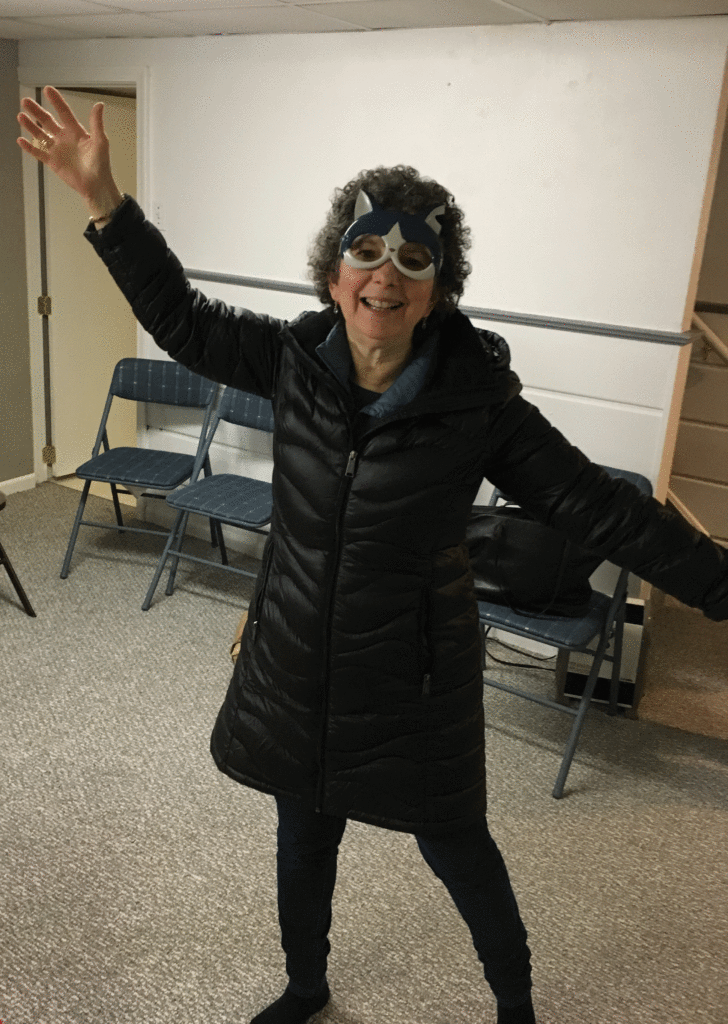
Getting me ALL BETTER. My husband is a real go-getter, and lately he’s been of a mind to get me ALL BETTER. He’d like me to be one of the people who get a clean bill of health when they go to the doctor. In my case, that would be a CBC (complete blood count) that is totally normal. Now look at my picture. Do I look like a normal person? (Don’t answer that.) Sometimes I don’t even try.

But back to my husband and his quest. He and I were scheduled to go the Weston A. Price Foundation (WAPF) Conference last November. (Check out their podcasts; they’re amazing!) Unfortunately, I came down with a cold from hell (was it the flu? I’m not sure) right before our scheduled flight. We were meeting a friend, so hubby went without me. I have to say that the WAPF is loaded with wonderful information. He was in Baltimore for three days of expert speakers on all things health. And being my husband (I know him well; it’s been 42 years) he came home with books, and also ordered ALL the recordings of not only the 2018 conference, but also the 2016 and 2017. It’s a bonanza of information. My husband is driving me crazy!

Don’t get me wrong. I know that his heart is in the right place. He loves me and wants me to keep living, which is a wonderful thing. And despite the fact that I feel like a Girl Scout (or maybe a Tibetan nun) about my lifestyle and eating habits, he has been encouraging (okay, pestering) me to CHANGE. As much as I proselytize about taking charge of your health on this site, I understand what it’s like to be on the receiving end. It can be a challenge, and sometimes I’m grumpy.

Here are the changes I’ve made so far.

  1. IF (intermittent fasting). This could be its whole own post. But briefly: the point is to put as many hours as possible between your last meal of the day and your breakfast (break-fast) the following morning. I’m up to about 16 hours now. It sounds like a lot, but it’s not really. I finish eating dinner at about 7pm, and don’t have breakfast till about 11am. I do have coffee and tea, and sometimes some chicken broth. The point is to give your digestive system a chance to not only get the obvious job of digestion done, but also to start scavenging around the body and ridding it of pathogens and other odds items, like toxins, that don’t belong there. You are supposed to lose weight, but so far I have not. In fact, I started gaining weight. Oy!
  2. Lowering my carb intake. Okay, if you start following the now-popular KETO diet, the point is to eat animal protein (but not to excess), lots and lots of fat (nuts, seeds, butter, olive oil come to mind), and low-carb vegetables (skip the root vegetables and stick with the leafy stuff), and a bare minimum of fruit. This has been challenging and I’m not there yet, and may never be strictly KETO. What I have changed, as of a week ago, is I’ve eliminated my morning smoothie as the only way it is palatable to me is with a LOT of fruit. Good fruit like berries and green apple, but still… a whole lot of it. Instead I’m having eggs or sardines with avocado, mushroom powder, and some nuts. It’s actually delicious, so no problem there.
  3. Epsom salt baths. Okay, I’ve only had one, but it was wonderful! You take a bath with Epsom salt and baking soda (Google for amounts; I think I used too much) and soak for about a half hour. I did this before bed and I was warmed to my core and slept like a well-fed baby. Unfortunately, I was still woozy in the morning, but I’ve read that changes after several baths. This is supposed to detox, removing toxins from your skin, much like sweating in a sauna.

The results? I don’t have results yet! Well, I did lose weight since cutting back on fruit. But that is not really the entire point of this thing. I was my thinnest (too thin!) when I was Macrobiotic back in 2005, but not my healthiest. I will keep on posting and let you know what works, and what doesn’t. I just wanted to check in so that no one worries that I’m going downhill. I am fine. I really am. Please feel free to post any opinion you might have about these changes.

Wishing you good health and the ability to coast! – Denise

PS: I do actually work on that elusive book of mine. Maybe that’s why I don’t post as much as I should.
CLL and Intermittent Fasting

Denise and two of “her boys.”

Intermittent fasting has become quite the craze. Google it and you will see countless pages, including many youtube.com videos touting its safety and effectiveness. I agree…to a point. It turns out I’ve been intermittent fasting for years – but didn’t realize it. Does that sound crazy? Let me explain.

Before I started a truly healthy non-SAD (standard American diet), I would be ravenous for breakfast. I remember standing in the shower with true stomach PAIN gripping my being. I would speed dress and run to the kitchen for relief. Yes, relief. I wasn’t just hungry; I was crazy hungry. I believe the reason was sugar, and probably gluten. My standard breakfast at the time was a bowl or two of cereal, sometimes topped with bananas. At the time, I thought it was a pretty darn healthy diet.

Cut out the sugar and enjoy your morning calm. It wasn’t until I read Beating Cancer with Nutrition by Patrick Quillin and started cutting out most processed foods that I felt a difference. This difference became even more pronounced when I went on the Macrobiotic diet as taught by the now-defunct Kushi Institute in Becket, Massachusetts. At the Institute, they had morning exercises prior to breakfast. Before my Quillin-inspired diet, and the fare I was eating at the Institute, there was no way I could have made it through exercise class. I would have hopped in my car in a mad search for a restaurant or a supermarket. But I felt the change. Waiting was no problem, and neither were the gentle stretches and exercise. I’d already begun my Intermittent fasting; I just had no idea that was what I was doing. This was 2005.

I’m already intermittent fasting! In fact, it wasn’t until I recently (this is September 2018) listened to a Nasha Winters youtube.com video that I realized I’m an Intermittent faster! Dr. Winters said that fasting for a mere thirteen hours was enough to prevent breast cancer. Thirteen hours! I generally fast for fifteen! I will explain.

The hours of fasting include sleep. For me, this is about seven hours on a good night. The rule is to not recline or go to bed for at least three hours after eating. No problem. I’m usually done eating by 7:00 pm, and rarely make it to bed by 10:00 pm (even though that’s my target bedtime). Even if I set the clock for 6:00 am, which I generally do, I’m rarely out of the house till 9:00 or 9:30 am, and I let myself have my morning smoothie at 10:00 am or later, when I’m at my desk, ready to work. (I often have some sauerkraut or pickles at about 8:00 am, and a cup of bone broth soup at around 9:00 am. According to the experts, these “treats” don’t count. If you haven’t had sugar or carbs, you are still in IF.) The last time I checked, 7:00 pm till 10:00 am is fifteen hours. And I often go longer than that. Without any struggling.

Is this the reason for my continued good health? The point is that I’m doing well, or at least well enough. I’m seventeen years into this CLL gig, and my numbers are similar to what they were at diagnosis. (Please note: I still most definitely would be diagnosed with CLL if I went to any doctor for the first time. I’m NOT cured, but I certainly am a well and healthy human being!)  The short answer to this question is: yes, but. Yes, it is part of why I’m doing well, but it is most certainly not the only reason. There are also the large issues of diet, supplementation, exercise, sleep, clean water and air, and the general avoidance of toxins.

So how does IF work? Yes, this is an important question. Our bodies are complex and busy machines. We all know that we heal best overnight. When we’ve suffered a cut or minor injury, we often find it at least partially healed in the morning. When we have the flu or other minor illness, there is nothing quite like a good night’s sleep to help us recover. Our bodies are designed to heal. When we are at rest, our internal machinery is busy at work, our immune systems on high alert, clearing out the toxins we’ve come across, kicking out the pathogens (germs), rebuilding damaged tissue, and so on. While it’s not a cure for CLL, it is certainly one of your major pillars of health. It’s a wonderful system, but there is a hitch.

If we’re loaded up with food, the body must divert its energy and attention to plain old garden variety digestion. What a waste of energy and time! This is why it’s vital to stop eating a good three hours or more before bedtime. Your digestive system will have had plenty of time to work on its latest load of nutrients, giving the immune and reparative systems what they need to help heal your body. It’s a beautiful system. Don’t muck it up with late-night snacks.  Water or herbal tea is fine. Stay away from caffeine; your body doesn’t do this repair function nearly as well when you are awake.

Intermittent Fasting Side Effects. It’s all good. IF can improve your heart health, suppress inflammation, fight free radical damage, and more. In general, it’s just plain good for your overall health. While many use this method of eating to lose weight, that has not been my experience. Read more about IF in this article by Dr. Joseph Mercola.

Check out your eating schedule. If you’re already cut out the sugar and glutens, chances are you’re not starved all the time, and eating day and night. You might already be intermittent fasting. It might be that you’re close, but still eating a late-night snack. It’s hard to make those changes. But now that you know about the mechanism of self-repair and healing, perhaps you’ll find it worth your while to try.

[Please note: my husband (who I adore) pushes himself and pushes me to be my best. He nagged me (sorry, but that’s the most accurate word) to keep my hours between 5:00 or 6:00 pm at the latest and 11:00 am or 12:00 noon at the earliest. When I tried to meet this eating schedule I developed stomach issues. To be specific, stomach pain while sleeping that kept me up many nights. It turned out, on self-reflection, that I was rushing through dinner to get enough ‘fasting’ hours in. And I was famished by 11:30 am and didn’t eat slowly or mindfully.  In other words, I was stuffing my face, quickly, all during my ‘feasting’ hours, and it was hurting my health.]

Pay attention to your body. Maybe thirteen hours is your limit. Maybe twelve. The important thing is to go to bed on an empty stomach, and then to delay breakfast for as long as reasonably comfortable.


PS: If you wonder why I always post photos of my grandchildren…it’s because when first diagnosed I really didn’t believe I’d live to see weddings, let alone grandchildren. It’s a joy in my life and I’m grateful for my extra years. I wish them for you as well!