CLL: My Personal 20th Anniversary

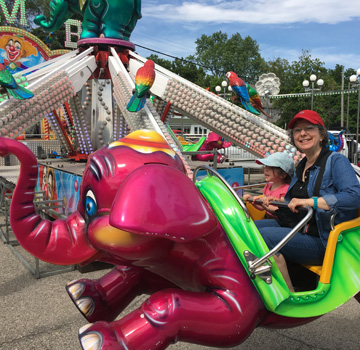
If pigs could fly…or maybe elephants. Here I am
with one of my six grandkids, having a grand time in the air via a pink elephant!

Celebrating My 20 Year Anniversary of CLL

I remember vividly when I was first diagnosed with CLL at age 46. It was July 2001, shortly before our national disaster. At the time, my brand-new oncologist told me that if I was lucky, I might even live for twenty years. Well, I guess I’m lucky, because here I am. And while CLL has definitely been a life-changing diagnosis, it has not been a quickly life-ending diagnosis, as I thought at the time. In 2001, chemo was the first line of action. And the research I looked up did not look promising. The researchers congratulated themselves on increasing survival time from 1 year to 18 months, calling that a fifty-percent improvement. Yikes! And the quality of life for those taking that chemo sure didn’t enhance those extra months, I’m sure. So, I was a terrified skeptic.

Of course, not everyone is dealt the same cards. Some people get their CLL diagnosis when they’re way beyond watch and wait (W&W). With impending threat to life, they ignore the stats and take their chances, and who can blame them! But from what I see on Facebook these days, there are a lot of us on W&W, and this gives us options. Better yet, it gives us time. Time to make a plan and to make changes. Better yet, there are many non-chemo treatments on the market today, some of them even advertised on TV. I’m glad they are available, and at the same time I’m grateful I don’t need that as yet.

To be honest, it took me a couple of years to stop feeling sorry for myself and get started on working on my health. I’ve learned a lot, met a lot of wonderful people, and in what I hope will be a short article I will share my experience.

Step 1: Learning about EDS

My husband and I talked with a stranger on a flight home from North Carolina (I’m in Michigan), and she told us about going to an alternative practitioner who did EDS, a form of electronic screening or testing to see what was wrong with you and what you needed to get well. Because of this conversation, I went to Ellen, a local nutritionist and alternative practitioner. I didn’t much like or believe in the testing. It was way too woo-woo for my taste. But she did suggest that I had a yeast problem, and further that I had to give up bread and all sugars (and my beloved Slurpees. (7Eleven’s frozen Cokes for those who are unaware). I obviously looked horrified as she said I should do that for a week and return.

Here’s where it gets dicey. She tested me again and said I took care of the yeast. Yes, in one week. But now she could see that I had parasites and needed some of her parasite killer bottles of supplements. I declined, and probably went home for a Slurpee. And a sandwich, and maybe a frozen fudge bar. But here’s the kicker. I had no idea that I would eventually be on a much stricter diet than suggested by Ellen. Today I am sugar-free, gluten-free, dairy-free, and worst of all…low oxalate. It’s a miracle I can find something to eat, but as I’m constantly watching my weight, I guess I’ve been able to meet that challenge. 😊

Step 2: Searching for a Cure

I went to various alternative doctors in Metro Detroit, looking for someone who could guide me to good health. Okay, let’s be honest, I was looking for a cure and willing to do just about anything to get there. None of these doctors provided that golden ticket, but one of them sold books in her waiting room. That was where I came across my first helpful book. I’m sorry but I don’t remember the title OR author, and can’t find it in my house. (My husband now uses books to prop things up on occasion, as I mostly read on my Kindle. If I come across it eventually, I will update this post at that time.) The point of this book was that you could ‘control’ cancer with diet and lifestyle. The start of the book recounted a sign in a wildlife park, “Don’t feed the animals,” the reason being the potato chips and twinkies were bad for their health…and therefore, what about us? To this point, at my hematologist’s word, I was still eating what I thought was a healthy diet. The fact that it included frozen Cokes and ice cream cones (quite regularly) hadn’t changed my opinion of my diet. This is where I started to make change.

Step 3: EMF Remediation

In late 2004, my husband was in the local library, reading a natural health magazine. There was an article about EMFs and it’s affect on health, as well as an ad for an EMF detector (gauss meter). We bought one. I started measuring. It turned out that our bedroom (in which we’d slept for 20 years) measured an average of 7mG (milligauss). The WHO (World Health Organization) at the time listed safe levels at anything under 2mG! We measured again with our electric meter box shut down in the basement. It didn’t have ANY effect on the milligauss reading in our bedroom! Creepier yet, the higher you held the Gauss Meter to the ceiling toward the back of the room (closest to the powerline, just about eight feet from our bedroom), the higher the reading. My husband and I didn’t sleep well that night and moved into a guest room.

Long story short, it took five months to remediate the issue. Detroit Edison (now DTE) did not take me seriously at first, but eventually revealed that they had an EMF department! That alone was no help. The EMF department’s goal was to make me feel like a fool. They didn’t talk about danger, but instead about my “comfort” level, like I was a lunatic. For the full story, see my other website, EMFDamage.com.

Step 4: Macrobiotics

 Despite my new and improved “anti-cancer diet” (my words), my WBC persisted in climbing. Keep in mind that I was now eating store-bought organic cookies topped with sweetened yogurt. I had a long way to go, but at least I was on the path. There wasn’t much encouragement on the Internet just yet. At the time, a Google search for “cure CLL” (or something like that) brought up a lot of depressing information about chemo treatments and life expectancy. Or, worse yet, end-of-life planning. So I went to the bookstore and started searching for books. I might have even bought some online. One favorite was, I Beat Cancer: 50 People Tell You How They Did It. That led to many other books about the Gerson diet, the Breuss cure, and others. But the one that stood out, spoke to me, if you will, was The Macrobiotic Way, by Michio Kushi, which led to a trip to Western Massachusetts, to the now-defunct Kushi Institute for a week of intensive study of the macrobiotic way, which includes diet, exercise, and lifestyle.

I was on the healing diet for nearly two and a half years. I saw the most improvement in the first month. But at the end of two years, my WBC started to climb back up. Worse yet, I was diagnosed with both anemia and osteoporosis/osteopenia. I started adding animal protein and smoothies to my diet. To this day, both the anemia and osteoporosis remain a challenge. Although I eventually left the diet, many of the principles remain. I eat mostly organic vegetables. I don’t cook at high heat. I don’t have white sugar or white noodles (or any noodles for that matter), I wield a large knife against my wooden cutting board in the kitchen. Even in non-Covid times, I rarely eat out, and buy a minimum of processed foods. I am mindful of my stress level and strive to be calm. My husband had noticed my change of personality. I’m no shrinking violet (I’m not shy!) but I rarely agonize about things over which I have zero control.

Step 5: Laetrile

While I don’t believe that vitamin B-17 (amygdalin, laetrile) is a magic bullet, I consider it to be one of the many pillars holding up my health. But in 2007, I didn’t take it lightly. I’d read Dr. Phillip Binzel’s book, Alive and Well: One Doctor’s Experience with Nutrition in the Treatment of Cancer Patients. This book gave the stories of patients of his that had survived cancer via (in his opinion) the use of B-17. I was thrilled to read that one of the patients had CLL. Like a detective, I tracked her down, and unfortunately, I was able to speak only to her husband as she’d recently passed away. Of course this was sad, and discouraging, but I spoke with her husband at length. He felt certain that her life had been prolonged by Dr. Binzel and his protocol. He also admitted that while his wife took the B-17 and even had it via IV treatment, she found it hard to stick to the diet. Given their experience, I felt this was worth pursuing. Time for another road trip.

My husband and I drove east again, this time to Suffern, New York, to the Schachter Center, where we met with Dr. Jeffrey Kopelson. I’m sorry to say that he died several years ago, suddenly, from a heart attack. While I wanted to have B-17 via IV treatment, he advised against it, as it requires many visits and would have been useless during our three-day stay. Instead, he advised taking 500 mg, 3X/day, starting with one pill a day and working my way up to the full dose. I’ve been taking it ever since, and order mostly from TJSupply.com. I’ve heard good things about ApricotPower as well. Read more HERE about how Laetrile works.

Step 6: Ultraviolet Blood Irradiation

This was probably my most exotic treatment to date. I found a doctor about an hour and half away, near my alma mater, Michigan State University, in East Lansing. At first, I went three times a week, then two, then once a week, then every other. The process is that a technician inserts an IV needle and withdraws a pint of blood into a glass container. Your blood is then returned to your body, via that same IV, once it’s gone through an ultraviolet light machine they have for this purpose. It was painless (except for the first poke) and relaxing, and I met many other interesting cancer patients. I eventually stopped after examining my lab chart. I keep my own spreadsheet. I determined that while I was no worse, I was no better. It wasn’t worth the time and expense. This was my experience, and I know that this works well for other people. So please don’t be discouraged if you’re considering IVBI therapy. It’s definitely worth a try.

Step 7: Patient Heal Thyself

One thing I learned about going for the IVBI treatment was that I didn’t have to go to my hematologist for blood work. As I was so frequently going to E. Lansing, where they were drawing blood anyway, I’d gotten into the habit of getting my CBCs done there. It was so much less stressful than a trip to the hematologist where you had to see the people getting chemo while you waited for your blood draw. I used to dread those visits.

But it was a nuisance to go all the way to East Lansing. My son, then a nutritionist, suggested that I use DirectLabs. You go online and order up your tests. The cost is out of pocket, of course, but not much more than the copays I had at the time. You receive a voucher and locate a participating blood draw location. Today I use Quest locations but have used Labcorp in the past. Your results are emailed directly to you. I don’t recommend this if you’re not familiar with reading your own lab results. Or if you feel the need and reassurance of a medical professional. I do a mixture of both. I see a doctor once a year, and get blood draws every three months. It’s been working for me. I don’t like to be surprised and this keeps me in tune to what’s happening with my body as I continue with my diet and with often changing up supplements. It’s a good idea to check with your doctor to make certain that this is a good plan for you.

Step 8: Living with CLL

There are many with CLL who have reported that they have been totally healed from CLL via natural means. I’ve spoken with three of them, all men. I’ve read about two more. This is wonderful and an inspiration to all of us. It can be done! There is a path, but it is our job to find it. Unfortunately, this has not been my experience. I still most definitely have the diagnosis of CLL. Every blood test proves it.

However, and this is a big however, in some ways it doesn’t matter. I’ve changed up my lifestyle and my diet. I’m ever watchful of my lab work. I eat virtually zero processed foods and nothing (zip,zero,nada) foods made with white sugar. Ever. It’s not even that big of a challenge anymore. It’s just the way I live. But while I’ve been working on this, wonderful things have happened.  I’m still here and living my life. I’m still working. I’m still writing and even drawing and illustrating these days. Best of all, I’m still here with my husband and two sons and their families. And as you’ve probably seen, we’ve had six little additions to the family over the last eight years. Six grandchildren! Such an unbelievable blessing! I am grateful every day. If anything has been worth all the work, and all the work to come, it would be this.

Step 9: Sharing

I really left out a step. I believe that it was in 2011 that I started my web site, CLLAlternatives.com. I was worried that I would depress the hell out of people if I died and therefore stopped writing. But it’s been nine years since then, and here I am. Sharing has enabled me to meet and enjoy the friendship of countless CLL Buddies. I keep in touch with people from Ann Arbor (45 minutes away) to London, Spain, Canada, Washington, D.C., New York, California and Florida. There are so many more! Some of these contacts have been fleeting. Many of you I consider to be friends. We are all bound by this terrible and shocking diagnosis that turns into something we can live with. I truly love you all!

As usual, I’m thinking of many more things I could say, but this is long enough. I hope you are inspired to keep on keeping on. Keep up your diet, your lifestyle. Keep testing out supplements and make changes as your health dictates.  Check in with your doctor, but also remember that you are the final decision maker of your own health.

Wishing you all the best of health and happiness! – Denise
CLL DIY treatment

How long do I have to do this!

When I first started trying to treat my CLL naturally, as a DIY project at home, I was still thinking in conventional medical terms. In my mid-forties, I was working towards a CURE, after which I could return to my NORMAL life. (Yes, I’m yelling; there was a lot of passion at that time.) My normal life was seductive, filled with coffee houses, chocolate cake, frozen Cokes, and frequent ice cream cones. I wasn’t fat or food obsessed, but that was my life and I liked it, thank you very much. I was also fond of not worrying about dying young and leaving my sons and husband behind. It was a very bleak time.

CLL as a DIY project. So after a long period of fear and self pity, I started working on my health. Initially, I felt that it was futile.  Locking the barn door after the horse was already stolen. Damage done. DNA ruined. Nothing I could do but watch and wait for the inevitable. I remember going to a local nutritionist/homeopathist who did one of the electronic tests and told me I had a yeast problem and that I needed to go on the yeast diet. This meant no sugar, no bread, no cookies, no frozen Cokes. All the goodies. I was a bit like an addict. I told her I could do it for 5 days, that was it. And I meant it. 

The Anti-Yeast Diet. I was true to my word and I stuck to this seemingly hideous diet for five miserable days. After that, I did, over time give up my precious frozen cokes and ice cream cones. I started buying organic cookies and slathered them with organic yogurt. Okay, I wasn’t there quite yet. The point is that I wanted an end game. And there really isn’t an end game.

The Macrobiotic Diet. Fast forward to 2005. After four years of a CLL diagnosis, my WBC had climbed to the low 20s, which at the time totally freaked me out. So after some research on the Internet, my husband and I packed our bags and drove to the Kushi Institute in western Massachusetts to learn macrobiotics. I was going to CURE myself with this diet, and then I could return to NORMAL. The macrobiotic diet was even more stringent than that hideous yeast diet. It consisted of beans, greens, brown rice and seaweed, with a weekly treat of white fish. It allowed for tempeh, tofu, sauerkraut and seasonings, one whole tablespoon a day of olive oil (no other fats) and lots and lots of kombucha tea. 

After one month of trying it at home prior to our Kushi visit, I lost about 10 pounds and my WBC had returned to 14, where it was at diagnosis. This is why I expected a CURE. I stuck to the healing diet for nearly two and a half years. I was extremely thin. I was waiting to improve those numbers, to get back to NORMAL so I could STOP. (Yes, I’m yelling again, because that’s how I truly felt.) But I didn’t get down to normal. In fact, I stopped the macrobiotic diet at two years and four months because my white count started once again to climb. Also, I was tested and found I had both osteopenia and osteoporosis. And anemia. It was time for a change. 

Reconfiguring my diet. So we got into the car once again, and this time drove to New York where I met with Dr. Kopelson (now deceased) of the Schachter Center (now closed) in Suffern, New York. I returned once again to taking supplements, something not allowed in macrobiotics. I also started juicing, and very slowly started adding eggs, chicken, and fruit. No more tofu or tempeh, yay! (I didn’t like them at all.) But once again, as I started up the supplements, I recall asking the doctor how long I had to do this! Because my goal was still to get CURED, and get back to NORMAL. (Yes, I’m yelling again.)

A (Very) Gradual Turnaround. So when was the big turnaround? When did I realize that this was it? That this WAS my normal? I don’t know. It was a gradual process. I didn’t start writing this blog until 2012, at the urging of my husband who felt that I had a lot to share. “But I’m not cured! I might still die of this and get everyone who reads this all depressed.” But my husband pointed out that it had already been 11 years, and that many newly diagnosed people would still appreciate my words (even if I were to keel over momentarily). Two major factors helped in the turnaround. One was finding out that I had to heal my gut. (Digestive issues had been a life-long problem.) The second was that I could no longer eat food cooked at high temperature. (Burnt food is a known carcinogen that immediate raises our white blood count.) All the efforts put into these two factors, along with my supplements and lifestyle choices, started to turn the course of my CLL markers. It wasn’t one major revelation, or one major pill. It was and still is a process, a continuing process.

The Secret Revealed. Some time after 2012, it finally occurred to me. I had to keep working on my diet and my lifestyle…indefinitely. That’s right. Just like the sign in my dentist’s office: only floss the teeth you want to keep. There you have it. There IS no cure, at least none that I’ve found. There is only management. You have to take the supplements, eat a healthy diet, get exercise and good sleep, drink clean water, breathe clean air, so long as you want to live. Once I got this in my noggin, my attitude changed. No more anxiety about getting cured (CURED!) by a certain date. No more figuring out how to reduce the number of supplements I take (I do take a boatload.) No more dreaming about bumpy cake. Nope. 

Grandchildren and Happiness. The tradeoff is that I no longer worry about my longevity. I’m fairly confident that if I follow the path I’m on that I will continue to be well enough to live my life. So far, I’ve been fortunate enough to see both my sons marry wonderful girls and to become the deliciously happen grandmother of six wonderful uniquely lovable grandchildren. Not too bad for giving up frozen cokes and ice cream. If I’d been given that choice in 2012, I would have been happy to take it.

Forget the Cure and Stay the Course! So if you’re working on a cure, please stop! Once your body has been a host to cancer, that potential is always there. It is your job to make your body as unpleasant for cancer as possible. This means… no sweets, minimal processed foods, minimal fruit, organic clean produce, wild caught fish, free range chicken and beef, and a good working immune system. In short, clean air, clean water, clean food, good nights’ sleep, and regular challenging exercise. Cancer feels unwelcome in such an environment. It is your job, every day, to maintain this inhospitality – and to keep living the good life – your own. 

CLL: Facing the Fear and Loneliness

I just answered an email from a CLL-buddy who is feeling the fear and loneliness of a CLL diagnosis. She does not want to burden her husband by dwelling on her dark thoughts and worries about CLL, and her friends don’t seem to be any comfort. Of course not! This worries them too, and while they wouldn’t say it to her, knowing that a friend has a potentially fatal diagnosis makes them worry about their own lives, as well as about their friend. So what is a person to do? This was my answer to her:

Dear CLL Buddy,
I do understand how difficult it is to keep a happy face on this when you are so frightened. Eventually, you will feel confidence in yourself and in your health, and you won’t feel so frightened. Believe me, you are not alone in having fear of CLL! Here are a few suggestions that have worked for me.

1. Allow yourself to be frightened or upset for only one day at a time, particularly after a blood test that wasn’t what you wanted.

2. Research. The next day, concentrate on the blood marker that concerns you, and start some research on what you can do about it. Look up supplements and herbs. Make a lifestyle change, etc.

3. Have fun! Find time every day to do something you enjoy that is relaxing and gets your mind off of CLL! Read a book, go to a funny movie, visit with a friend (and not talk about CLL) maybe shopping or an art museum or something that you find fun (and gets your mind off the CLL).

4. Find your own personal meditation. I’ve tried meditation tapes (now they would be CDs or better yet, mp3s). This wasn’t for me, but many people find relief in this. My personal meditation is reading novels or writing, or even drawing. I have sketch books, and I find that when I’m sketching, I’m not thinking of anything but the pencil and sketchbook. I lose track of time. It is wonderful! Think back to childhood and what you enjoyed doing that made you lose track of time. Give yourself a gift of figuring this out, and then act on it!

5. Get a good night’s sleep. Make your bedroom light-proof so you can get a good sleep at night and make your own melatonin. Nothing makes you feel better than a good night’s sleep!

6. A new watchword: you are NOT about to explode! Any doctor that would see you today would send you home and then go about his or her business. You are not in imminent danger! Enjoy today! None of us know if there is a tomorrow (we get hit by the bus, etc., who knows?) So why waste today? Enjoy it! It is a gift you are squandering on worry.

7. Recognize that you can gain control of your health. It wasn’t until I became Macrobiotic (ironically, I am no longer macrobiotic, but still…) that I started to see the control I could exert over my CLL diagnosis. After one month of giving up all processed foods back in 2005, my WBC dropped back to 14, where it had been at diagnosis. While I’ve moved on from Macrobiotics, the lesson learned was that I COULD get control of this CLL thing. Since then, I’ve also learned that healing is all about the gut, the digestive system. Work on your digestion and you are working on your health! I’ve not been able to get to where my blood work indicates I’m CLL-free, but I am back in stage zero.

8. Seek out a therapist. If all of this leaves you worried still, see if you can find a therapist. There is nothing to be ashamed of about this. You are facing down your mortality, and we don’t like to do that. It is crazy-making. Back in 2003 or maybe 2004, I was constantly crying with worry and wondering how my boys would grow into manhood without me there. I worried about my husband. I cried about never meeting grandchildren. And see, all those tears were a waste of energy. That said, I DID see a therapist at that time, and it really helped me.

What I learned from him at that time was that I had to take action. Until that point, I felt like I was a victim; I had this CLL diagnosis and I believed it was too late to do anything about it. Damage was done, and I had to accept my fate. Now THAT was crazy! There was so much I could do, but talking to this therapist helped me see it. 

If you continue to be depressed, please find someone who might help. If they make you feel worse, find a different therapist. But do try all the other items above, first.

And I AM here for you. So please write whenever you need to. I do truly understand. I’m wishing you radiant health and a wonderfully happy day! Love, Denise

PS Writing about your worries here, on the site, really helps others. We’re all in this together!

CLL: Mushrooms and Neutrophils

CLL Mushroom Powder
CLL Mushroom Powder

In a recent email one of my CLL buddies wrote and told me about her improvement in neutrophil count She had been taking  600 mg of shitake, four tablets of Maitake-D Fraction, 1950 mg (3 tablets) of Reishi, and two tablets of AHCC. She noted that her neutrophil count went up to a high normal at her next blood test! Great news!!!

After this success, she experimented by dropping to a 1/4 of the dosage. Unfortunately, at her next blood test, the neutrophils showed a rapid descent. It was no longer in normal range. This CLL friend of mine wanted my opinion of what to do.

Management vs. Cure
Of course, I told her to go back on the dose that worked for her! Not as a doctor (of course) but as a CLL friend. The reason being — and this is so important — we are not curing our CLL by everything we do and all the supplements we take; we are managing it! Let me repeat…it would be wonderful if we all could have a home-made cure. I’ve spoken to three men who feel that they have, in fact, beaten CLL by DIY, home-done efforts. This has NOT been the case for me. I still would be diagnosed today if I had a blood draw for the first time. They would call me in or call me back to give me the hideous news. And yet, here I am, alive and quite well (thank you very much) after 17.5 years at this. Why? Because I am managing the disease, and this is working for me!

Now, why do have the photo of mushroom powder on the top of this post? Good question. Because of this CLL friend’s email, I reviewed my own history, my supplement notes in particular. I used to take the Maitake D Fractions, and that was at a time when I was starting to show real improvement. (At that time, my WBC went down over 20 points and for a change my RBC didn’t nosedive along with it. Whew!) I was also cooking low and slow at that time, and I gave that one thing a lot (maybe too much) credit.

After I stopped taking the Maitake D Fractions (recommended by one of the CLL healed, no less) I substituted by buying dried shitake mushrooms and grinding it to add to soups and stews. Later (I really don’t know when) I started buying organic mushroom powders, and adding a scoop to my smoothies I have about five days/week. The good health, including normal absolute neutrophil counts, continued, and continue to this day.

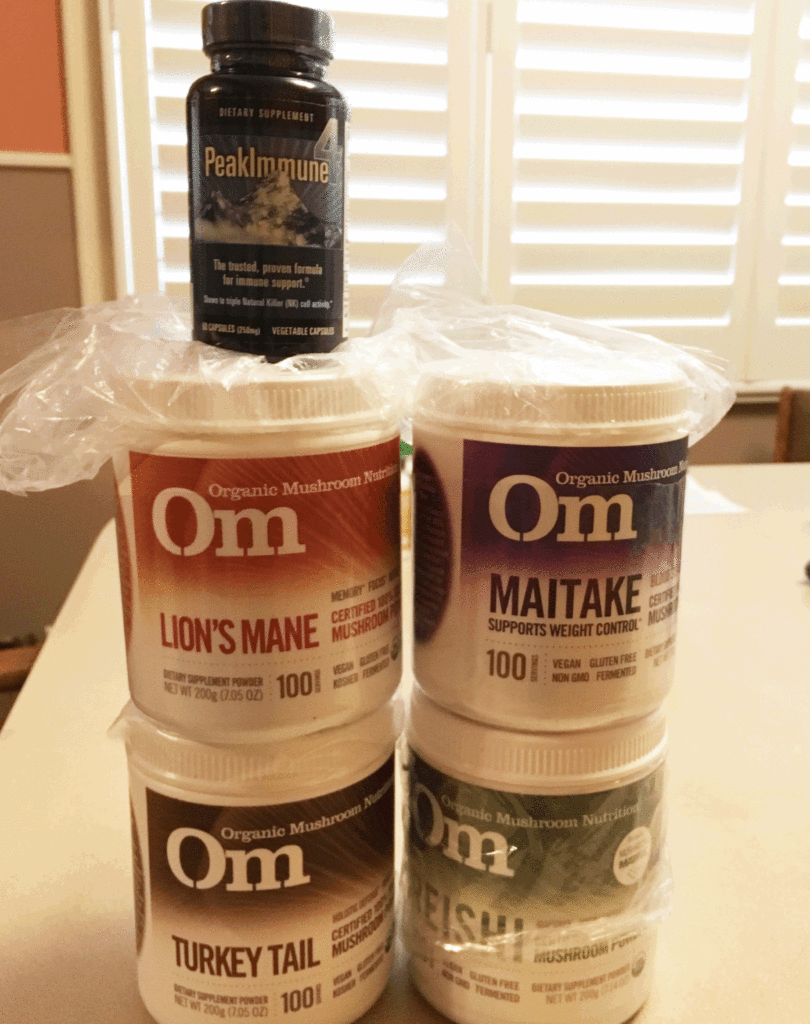
I mix up the type of mushrooms. The pictured above are just four of the variety that I alternate day by day. If you do a search on each of these mushrooms, along with “CLL” you will see there is evidence that this food (not a medicine) is good for you! It helps people with CLL! The types of mushrooms I take regularly include shitake, maitake, reishi, cordyceps, lion’s mane, and turkey tail. I have no favorites; once they’re mixed in the smoothie I can hardly tell they’re there.

Are Mushrooms ‘the’ Cure?
Do I recommend that you drop everything else and start taking mushroom powder and that this alone will heal you? Not such a good question this time. The answer is NO! Getting cancer or leukemia is a comprehensive process, and so it healing yourself enough so that you can continue to live a good life. All the other pillars that create health matter: clean food, clean air, clean water, reduced/managed stress, good sleep, meditation, finding joy in life; these are ALL critical, and not something that you will find in your oncologist’s office. Perhaps not even in your alternative practitioners office. We need all our professionals, but to be well you have to count on yourself.

What about the Peak Immune? I’ve written about this product before. I am NOT affiliated with this company or any other. This is a non-profit site written only to share and help! I started Peak Immune years ago, at the advice of a Chinese herbalist (himself recommended by an alternative MD I traveled to see in New York.) Peak Immune is an immune modulator. This means that it regulates your immune system to the place it should be. Not ramped too high, and not dropped so low that you are in physical danger.

Peak Immune is not a mushroom. I believe it’s rice bran arabica, in this case a food derivitive. I’ve taken Peak Immune for years (cheapest in the States at LuckyVitamins.com, when you buy via autoship). It has been the one thing for certain that has increased my neutrophils. On the literature it says that it “increases the activity of NK (natural killer) cells.” So when I first started taking it, I wasn’t expecting it to increase my neutrophils But it most certainly does. Now, with the mushroom powder, I take only three Peak Immune capsules a day, and I seem to be holding steady.

You have to test this for yourself. Once again, this is my experience, along with the stated experience of a woman who wrote me recently. It is not harmful; it is a food. The mushrooms are not inexpensive, and neither is the Peak Immune. You don’t have to buy an arsenal like I do, but change it up, one at a time. And if you do try this, and test your results at your next blood draw, let me know — good or bad — how it works out.

Special request: While I do respond to emails, I think it’s kindest of everyone to respond directly on this site, to the pertinent post. This will help people on a search find not only my words, but your concerns, questions, worries, and your own answers and experience as well. I promise you will remain anonymous. It all helps!

As a final note, I am still working on my book. I will check in again, not necessarily “soon,” but please know that it is in progress.

Wishing you peace, joy, and the very best of health! – Denise

CLL The Cure is in the Grocery Store

Farmer's Market for CLL
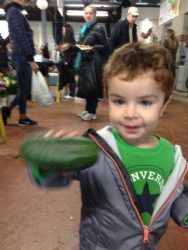
Shopping for a future pickle at our local Farmer’s Market.

Last night my husband and I had what we call “fast food” for dinner. Don’t raise your eyebrows; it’s not what you think. I tend to cook an elaborate dinner, in quantity suitable for leftovers, about three times a week. After that, we either eat leftovers combined with freshly steamed vegetables or a raw salad, or we make “fast food.” In this case, it was slow-fried eggs, corn on the cob, and steamed brussels sprouts.

Why is this fast? Dinner took considerably less than a half hour, and it was delicious! Before I get into recipes or cooking techniques (like what is “slow-fried”?) I need to make another point. Success in the kitchen, as measured by truly healthy and nutritious meals and snacks that taste good, require more than kitchen skills. They require shopping!

Shopping Time!

Yes, if you want to beat this CLL thing, and you want to do it naturally, you have to spend some time in the supermarket and, if available, your local farmer’s market. This is another case of failing to plan is planning to fail. You have to shop the stores in your neighborhood until you find the best places for abundant organic fruit and vegetables. Yes, I do eat eggs, chicken, fish, and sometimes even beef, but I still eat a plant-based diet. The animal protein is more of a side dish.

Times have changed.

It wasn’t long ago that I had to go to health food stores for a fairly limited and often dried-out selection of fresh veggies. Today, even the corporate behemoths (like Kroger, here in SE Michigan) have an impressively well-stocked organic produce section. My personal choices these days are Kroger, Trader Joe’s, and the local Royal Oak farmer’s market. They all have their good and bad points. We (hubby and I) often go to two markets in one evening for a quick, targeted shopping trip. We know each store’s layout and can get in and out quickly. Even with these quick  trips, keep in mind that you will likely have to do this at least twice a week. Some vegetables keep only so long, and if you’re doing it right you’ll find that your refrigerator has an ever-dwindling selection of fresh produce

Another time saver is stopping in on the way home. Hubby does this more than me, especially in the summer, as I take my dog, Tina, to work, and I don’t like to leave her in the car unless it’s cold outside. (It’s cold outside today now…sigh.)

Another side note: sometimes your organic produce choice won’t look so good. Sometimes conventional might be a better choice, in which case please soak in 50-50 white vinegar and water to cleanse as much pesticide residue as possible. Another choice to shop more than one market. If the selection at the first isn’t so good, you still have one more chance to get your organics.

And where do I buy all my animal protein?

This is not an answer set in stone. We still buy eggs from our local farmer’s market. They are consistently better than the organic eggs at any supermarket. The yokes are orange rather than yellow, and they are delicious! In the past my meat sources have been Trader Joe’s, Whole Foods, farmer’s market, other specialty stores. You have to continually be aware and look for the best places. Your local Weston A Price chapter can help you source local good foods.

The point is to BE PREPARED.

Shop ahead and get the best organic veggies and fruits in season. You can rinse and freeze the fruit. Store the leafy greens and other veggies in a loosely closed plastic bag so that some air can get in. This works for me, and it’s fairly simple. Simple is good. The more complicated you make your food gathering, the more of a task it will seem.

Of course, it’s not all about veggies and fruit. Also keep stocked with organic pastured free-range chicken and grass-fed pastured beef, wild caught white fish and salmon, and pastured free-range eggs. An extra freezer is wonderful, if you can afford it. Beyond that are the seasonings and sauces. I’m honestly not the most skilled cook, but I do keep tapioca starch (flour) on hand for mixing with water and seasonings and pouring over a stir fry when almost done. It turns into a delightful gravy reminiscent of a Chinese food dish.

Also keep organic, extra-virgin olive oil in the cupboard, along with apple cider vinegar, other vinegars (I love Eden-brand umi-plum…yum!) and balsamic vinegar as well. (all organic, please) A supply of fresh lemon is great  to add to dressings and sauces, and also to squeeze into a morning glass of water for your alkalinity and digestion.

Coming soon to a blog near you!

In another post soon, I will write about some of my favorite cooking techniques. Not only should your vegetables be organic and fresh, and your animal protein free-range, organic and pastured, but nothing should be over cooked at temperatures above 300-degrees Fahrenheit.  This is a challenge I’ve managed to overcome by checking out advice on Google and youtube, and by experimenting on my own. I am happy to share and will do so soon.

In the meantime, get out to your local market and start checking out the best sources and prices. You’re in this for the long haul. As environmental doctor Sherry Rogers wrote, “The Cure is in the Kitchen.” I would add, in order for that to happen you have to get to your grocery store first!

Happy shopping! – Denise

PS A good cancer cookbook is The Cancer Fighting Kitchen. There is an earlier addition at a greatly reduced cost on Amazon.


CLL and Intermittent Fasting

Denise and two of “her boys.”

Intermittent fasting has become quite the craze. Google it and you will see countless pages, including many youtube.com videos touting its safety and effectiveness. I agree…to a point. It turns out I’ve been intermittent fasting for years – but didn’t realize it. Does that sound crazy? Let me explain.

Before I started a truly healthy non-SAD (standard American diet), I would be ravenous for breakfast. I remember standing in the shower with true stomach PAIN gripping my being. I would speed dress and run to the kitchen for relief. Yes, relief. I wasn’t just hungry; I was crazy hungry. I believe the reason was sugar, and probably gluten. My standard breakfast at the time was a bowl or two of cereal, sometimes topped with bananas. At the time, I thought it was a pretty darn healthy diet.

Cut out the sugar and enjoy your morning calm. It wasn’t until I read Beating Cancer with Nutrition by Patrick Quillin and started cutting out most processed foods that I felt a difference. This difference became even more pronounced when I went on the Macrobiotic diet as taught by the now-defunct Kushi Institute in Becket, Massachusetts. At the Institute, they had morning exercises prior to breakfast. Before my Quillin-inspired diet, and the fare I was eating at the Institute, there was no way I could have made it through exercise class. I would have hopped in my car in a mad search for a restaurant or a supermarket. But I felt the change. Waiting was no problem, and neither were the gentle stretches and exercise. I’d already begun my Intermittent fasting; I just had no idea that was what I was doing. This was 2005.

I’m already intermittent fasting! In fact, it wasn’t until I recently (this is September 2018) listened to a Nasha Winters youtube.com video that I realized I’m an Intermittent faster! Dr. Winters said that fasting for a mere thirteen hours was enough to prevent breast cancer. Thirteen hours! I generally fast for fifteen! I will explain.

The hours of fasting include sleep. For me, this is about seven hours on a good night. The rule is to not recline or go to bed for at least three hours after eating. No problem. I’m usually done eating by 7:00 pm, and rarely make it to bed by 10:00 pm (even though that’s my target bedtime). Even if I set the clock for 6:00 am, which I generally do, I’m rarely out of the house till 9:00 or 9:30 am, and I let myself have my morning smoothie at 10:00 am or later, when I’m at my desk, ready to work. (I often have some sauerkraut or pickles at about 8:00 am, and a cup of bone broth soup at around 9:00 am. According to the experts, these “treats” don’t count. If you haven’t had sugar or carbs, you are still in IF.) The last time I checked, 7:00 pm till 10:00 am is fifteen hours. And I often go longer than that. Without any struggling.

Is this the reason for my continued good health? The point is that I’m doing well, or at least well enough. I’m seventeen years into this CLL gig, and my numbers are similar to what they were at diagnosis. (Please note: I still most definitely would be diagnosed with CLL if I went to any doctor for the first time. I’m NOT cured, but I certainly am a well and healthy human being!)  The short answer to this question is: yes, but. Yes, it is part of why I’m doing well, but it is most certainly not the only reason. There are also the large issues of diet, supplementation, exercise, sleep, clean water and air, and the general avoidance of toxins.

So how does IF work? Yes, this is an important question. Our bodies are complex and busy machines. We all know that we heal best overnight. When we’ve suffered a cut or minor injury, we often find it at least partially healed in the morning. When we have the flu or other minor illness, there is nothing quite like a good night’s sleep to help us recover. Our bodies are designed to heal. When we are at rest, our internal machinery is busy at work, our immune systems on high alert, clearing out the toxins we’ve come across, kicking out the pathogens (germs), rebuilding damaged tissue, and so on. While it’s not a cure for CLL, it is certainly one of your major pillars of health. It’s a wonderful system, but there is a hitch.

If we’re loaded up with food, the body must divert its energy and attention to plain old garden variety digestion. What a waste of energy and time! This is why it’s vital to stop eating a good three hours or more before bedtime. Your digestive system will have had plenty of time to work on its latest load of nutrients, giving the immune and reparative systems what they need to help heal your body. It’s a beautiful system. Don’t muck it up with late-night snacks.  Water or herbal tea is fine. Stay away from caffeine; your body doesn’t do this repair function nearly as well when you are awake.

Intermittent Fasting Side Effects. It’s all good. IF can improve your heart health, suppress inflammation, fight free radical damage, and more. In general, it’s just plain good for your overall health. While many use this method of eating to lose weight, that has not been my experience. Read more about IF in this article by Dr. Joseph Mercola.

Check out your eating schedule. If you’re already cut out the sugar and glutens, chances are you’re not starved all the time, and eating day and night. You might already be intermittent fasting. It might be that you’re close, but still eating a late-night snack. It’s hard to make those changes. But now that you know about the mechanism of self-repair and healing, perhaps you’ll find it worth your while to try.

[Please note: my husband (who I adore) pushes himself and pushes me to be my best. He nagged me (sorry, but that’s the most accurate word) to keep my hours between 5:00 or 6:00 pm at the latest and 11:00 am or 12:00 noon at the earliest. When I tried to meet this eating schedule I developed stomach issues. To be specific, stomach pain while sleeping that kept me up many nights. It turned out, on self-reflection, that I was rushing through dinner to get enough ‘fasting’ hours in. And I was famished by 11:30 am and didn’t eat slowly or mindfully.  In other words, I was stuffing my face, quickly, all during my ‘feasting’ hours, and it was hurting my health.]

Pay attention to your body. Maybe thirteen hours is your limit. Maybe twelve. The important thing is to go to bed on an empty stomach, and then to delay breakfast for as long as reasonably comfortable.


PS: If you wonder why I always post photos of my grandchildren…it’s because when first diagnosed I really didn’t believe I’d live to see weddings, let alone grandchildren. It’s a joy in my life and I’m grateful for my extra years. I wish them for you as well!


CLL: How to Eat

living well with cll
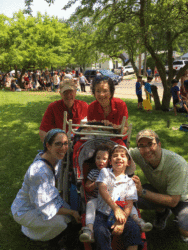
Living well with CLL! The author (in red) and some of the family, 4th of July 2018.

Please notice that the name of this article is not ‘what’ to eat, but how. We all think we know how to eat. After all, we’ve been doing this since birth. But sometimes we need a reminder. Let’s start with a scientific fact. Our immune system is strongly related to our gut, also known as our digestive system. Of course, it matters what you put into that system, that is more than true. But as someone who has struggled with digestive problems pretty much her whole life (at least as much of it that I can recall), there is much more to it than the food.

To explain, let me share my Macrobiotic experience. I was diagnosed at stage zero in 2001. In 2005, I was getting increasingly alarmed at my deteriorating blood markers. My platelets were low. My white count was high, and my hemoglobin and red blood count were also worrying. My husband and I did our due diligence and research, and we came up with Macrobiotics. I went to the book store and loaded up on several Macrobiotic texts and cookbooks. We also decided to make a trip over Labor Day to the Kushi Institute in Beckett, Massachusetts, for a week-long class. I believe it was called The Way to Health. (Please note, while I still eat an organic, whole food, mostly cooked-from-scratch diet, I am no longer technically Macrobiotic. Also, the Kushi Institute still has a web site, but they no longer offer the resident classes.)

The first thing I noticed was how the residents were skeletal thin. And many were missing teeth, which was concerning. But I was fighting leukemia here, and if I had to get thin and lose a few teeth in the process, well, that would be the breaks. As it turns out, I did suffer some gum recession and was about twenty pounds thinner than I am these days, but still it was absolutely worth the experience. I learned so much.

One of the first things I learned was to chew my food thoroughly. To count how many times you chewed, chewing until the food in your mouth was liquid — or as close to liquid as possible. To me, this sounded disgusting. But honestly, there is wisdom in this practice. The more work you consciously put into chewing, the less work your digestive system has in order to process your intake each day. When you chew, saliva mixes with your mouthful, adding digestive enzymes to the mix. Yes, those pills you buy in little bottles are naturally available if you just chew, chew, chew.

I’ve recently gone through a spate of serious stomach aches. I’m talking abdominal pain for a 36 hour stretch. Go to bed with a stomach ache and wake up with the same dull ache emanating somewhere from the left side of my waistline and radiating out to other regions of the digestive tract. I felt hunger but was afraid to eat. My husband was out of town on a business trip. I took to the Internet and looked up stomach pain and CLL, learned that it could be related. Of course, this led to a night of insomnia, keeping me from healing. I’m a strong person, but I sometimes also feel the fear.

When my husband came home, I shared my fears. He reminded me about the chewing. It’s so easy to forget. I started out by making myself meals of vegetable miso soup for breakfast, and chicken soup and rice (home made from the freezer, of course) for lunch. For dinner I had a smoothie. Everything I ate was either stewed or mush. Nothing required much chewing, but I chewed nonetheless. I feel better now, back on my regular diet, and I’m obviously very relieved. I was worried it could be the CLL, or my diverticulosis (or diverticulitis) kicking up. I was worried I might end up in the hospital where they would start running invasive tests and wearing down my immune system. (Conventional medicine saves lives, but you must be a careful and cautious consumer!)

But please take note that my main suggestion here is to chew your food well. Sit down when you eat and focus on enjoying your meal. Put a reasonably-sized helping of whatever you’re eating on your plate. Take a look at your plate before you eat and see if you agree that this is enough. Would you think it was enough if you were in a restaurant? That is your clue. Taking seconds will overload your gut and overwork your digestive system. When your digestive system is free from processing that food you put in there, it can work on making you healthy. That’s what IF/intermittent fasting is all about. But that, too, is another article. Just be sure to concentrate on eating while you’re eating. We tend to gulp food while walking around. I’m the worst while I’m cooking, and I’ve resolved not to do that any longer. So eat slowly and mindfully. Put down your fork between bites. Breathe.

So be well, enjoy your food. Eat hearty (but don’t overeat!), and chew, chew, chew!

Wishing you peace and the best of health!

CLL Book…Taking Topics

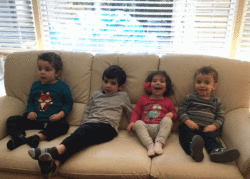
My four grandkids. It doesn’t get better than this!

It’s been a while since I’ve posted about writing a CLL book. I still want to! (I still haven’t.) I have compiled a list of important topics to be covered. I will list below. I’m taking suggestions. What would you like in a book like this (that isn’t included in the topics below)? I can’t promise that I’ll be able to write about any of your questions, but I have to say that when I read your comments, I always find myself learning more than I did when I first wrote the original post.

Here are my proposed topics:
(Keep in mind that a “topic” might turn into a whole chapter, or perhaps a small part of a chapter. It all depends.)

Living with CLL – It Doesn’t Have to be a Cure! (this might be the title)

Diagnosed with CLL: What to do? When to tell?

Doctors – Hematologists, Alternative Doctors, Alternative Practitioners/How to Find/ How to Choose

Blood Tests – what matters on a blood  test. Using DirectLabs.com

Supplements – What I (Denise) take and why. How to evaluate what to take yourself.

Alternative Treatments – Ultraviolet Blood Irradiation-Accupuncture- Vit C IV – Laetrile IV

Managing the Fear of a CLL Diagnosis

CT Scans and Other Tests

Cooking Low and Slow for CLL – Why? How? Basic Recipe?

Eating Organic Foods

Do I have to be Vegan or Vegetarian? Food Options: Veg/Fruit/Meat/Poultry/Fish/Nuts/Seeds/Dairy and ratios

Bone Broth Soup – benefits and instructions

Fermented Veggies – benefits and instructions

Eating Out/Plan Ahead or Plan to Fail

CLL and Living a Non-Toxic Life/pesticides/lawns/EMFs/house cleaning/personal care products/EWG.org/clothing/sheets/etc.

My Macrobiotic Experience and How it Helped (even though I’m no longer macrobiotic!)

Either You’re Committed or You’re Not/doctor has 15 minutes and you have  a lifetime/drugs/radiation/chemo/
(My husband and I disagree on this one. For the record, I think it’s fine to have conventional treatment if your life is immediately on the line. However, if you’re going to get well as a DIY project, if you’ve had conventional treatment or not, you have to live this lifestyle every day. EVERY. DAY. Hubby thinks it’s okay to do some things, that it’s better than nothing. I say, if you want results, get committed!)

Never Stop Learning

This is my list to this point. I am more than open to suggestion! Please comment. As always, wishing you all the very best of health! – Denise


CLL: Curable? Manageable?

CLL Alternatives
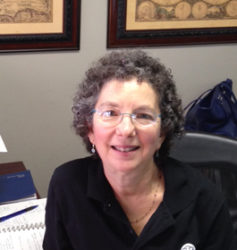
Me (Denise) at my desk at work. Notice the journal, to my left, and my MacBook Air (not visible, but just to the front of the notebook), where I am penning a book about my CLL experience.

Hello, It’s September 1st of 2017, and I thought I just might be overdue on making a post here. An update, if you will. I’m doing fine. Great, even. As a matter of fact I pay more attention to my signs of aging than I do my CLL, which is amazing! When I realign my psyche, I realize that I’m totally grateful to be living long enough to worry about wrinkles! Yay. I’m 62, and I have four grandchildren. When I first started this CLL Odyssey, I wasn’t at all certain I’d reach this stage or status. But I have. And the more I read and learn, the more I believe that it’s not a fluke. Others have done it, and I’m doing it, too.

WBCs and other markers. When I was first diagnosed in 2001, my WBC was a paltry 14.something and I was in Stage Zero. Of course I was still totally freaked out, and gearing up to die sometime soon. Despite all my efforts, my highest WBC was somewhere around 47, in 2012 or so. (I don’t have my Excel Chart with me.) Today, at last reading it was 17.something. Better yet, it’s been in the teens for about over a year. And my hemoglobin, which has dipped as low as the 10s, has been consistently normal, and over 12, for the same period of time.

My magic bullet? I don’t have a magic bullet. And I’m not cancer-free, either. If I went to the doc’s office for the first time and had a blood test, I’d be diagnosed. (I’m working on this, but not at all with the fear factor; I just work to be as well as possible, very consistently.) But back to the magic bullet. Over the years (since 2001), I’ve changed up and tweaked my diet several times. I eat zero processed foods, I buy and eat organic as much as possible. I slow cook all foods, vegetable and animal protein. This means I have soups and stews, and slow stir fries, which all happen to be delish! I eat no sugar or gluten, and the only dairy I eat is grass-fed butter. I’ve gotten rid of all toxic home care and personal care products. (This means I clean my house with baking soda, vinegar, and peroxide.) I exercise on an elliptical trainer, rebound, and lift weights 3-5 times/week. A big part of my daily/weekly diet is home-made fermented foods (sauerkraut and pickles) and bone broth soup. And I take a boatload of supplements, including my 9000 IU of vitamin D3 and four Peak Immune pills (by Daiwa) every day. I (try hard to) get to bed by 10 or 10:30 and get a good night’s sleep. And it is my goal to make my life as stress-free as reasonable and possible.

Okay, that’s my magic bullet. Or my magic ammunition. Sorry, I know it’s not an easy answer. But it works! It’s possible that if I tweaked just a bit more, I could get those numbers down to normal. But honestly, I’m pretty happy where I am. Watchful. Persistent and consistent. (I don’t cheat. Ever.) And despite all those changes, I feel like I live a pretty normal life. We enjoy our grandkids (and their parents), go out with friends, entertain. We even travel. Traveling is challenging, but worth it. We try to rent hotel rooms with kitchens, and bring enough food to make it comfortable. If it’s a weekend away, I just order a lot of salads in restaurants, and eat oatmeal for breakfast. But if it’s a week, and that’s the longest we ever go, we pack cooking equipment and containers to take food with us on bike trips, or wherever. It’s not normal like everyone else, but it works. It’s still fun. I guess it’s our “normal.”

A CLL Alternatives Book. I’ve decided to write a book. I know that the information in this web site is disjointed. I know I should spend more time on it. But despite all my best intentions, I normally do not. But I am a writer at heart. And I’ve started to pen a book that puts all of this information into perspective. And into chapters. This is not a money-making venture. I plan to have the book available as an ebook on Amazon for  $0.99 and I will sell the POD (print-on-demand) book at cost. (Whatever they charge me to put it together, that will be the charge.) So whoever needs the book can have it. Once again, the book is not necessarily a blue print for what exactly to do with a CLL diagnosis. Because we’re all different. But…it will be a blueprint for learning and testing until you find what it is that YOU need to do to be well. I’m sure there will be a lot of commonality in everyone’s approach. And keep in mind that conventional allopathic treatment (chemo, etc.) is also not one-size-fits all.

This will be a long process, but I’m making my commitment here. My husband also wants to post videos of interviews and cooking demonstrations. I think the cooking would be helpful. I unfortunately learned how to cook naturally after our boys became adults and flew the coop.

Two Book Recommendations. Before I leave, I have to recommend two books. By rights, they should each be a separate blog post, and eventually (no promises) they may be. Both books opened my eyes and made me see that what I’m doing makes sense. And my results also make sense, too. I will go into no more detail but to say, please read these books! If you can choose only one, choose the The Metabolic Approach to Cancer, as it is most instructive of how to fight cancer with nutrition/etc. However, if you or a loved one has a leukemia or cancer diagnosis of any kind, you deserve to read Tripping over the Truth: How the Metabolic Theory of Cancer is Overturning One of Medicine’s Most Entrenched Paradigms.

Please respond by post or shoot me an email. We’re all in this together!
To your good health! – Denise

Supplements for CLL

CLL supplements
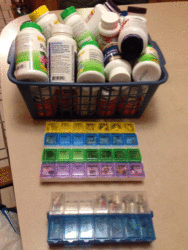
My two pill boxes. (My daily/weekly pills will not fit into one box.) And most of my pill bottles. I keep a dispensary of back-up bottles (not seen) in my cupboard.

I recently was emailed a request to update my CLL supplement list. My list of supplements is long, but not everything I take is because of CLL. I’m 61 (and a half), so like most people, I have other issues as well. I will therefore give a reason for each supplement I take.

The first is technically not a supplement. It is a glass of ACV (apple cider vinegar), lemon, and honey. To be more specific, a ‘splash” of ACV, half a squeezed lemon (or 3 tablespoons of ground whole lemon my husband makes in the vitamin with water and ice and saves in a jar in the fridge–nice hubby, eh?), and about 1 tablespoon raw local honey (we buy at farmers market or health food store). Add filtered water and stir. Drink with a straw. Rinse and brush teeth after drinking. It’s a great way to start the day!

Vitamin D3
5000 IU in the morning
2000 IU at lunch and dinner
for a total of 9000 IU.
People with cancer tend to be low in Vit D3, which we normally get from sun exposure. Mine was 19 when first tested.The goal for those with cancer is to get their vit d3 hydroxy test up to somewhere between 80 – 99. Mine has been as high as 100. Test frequently, and drop down the amount if you get too high. (I used to take 10,000, and now I’m down to 9000/day in divided doses.)

Ubiquinol
(a form of Co-Q10)
200 mg/breakfast
This is good for the heart. Both my parents have/had heart issues. I take this as a preventative. (I think it’s good for everyone, but do your own research.)

Krill Oil
667mg @ breakfast
this is the Omega 3 oil that everyone should take. Many people take fish oil. I prefer the krill. No fishy smell.

Astaxanthin
4mg/breakfast
This is one of those super antioxidants. If you take it during the summer, it protects against sun burn. (Doesn’t do the whole job, still have to be vigilant about that.) I take this one for general health.

B-17/Laetrile
500mg- bfast/lunch/dinner (total 1500mg)
This is an anti-cancer pill. Laetrile (found in apricot seeds, apple seeds and other natural parts of fruits) kills cancer cells and leaves normal cells alone. You may read that it’s dangerous because it is cyanide. Only half of that is true. The pill does act as cyanide in the body, but only when in contact with those cancer cells. I’ve been taking this dose since 2007 and I’m just fine. My source is tjsupply.

Curcumin
1000 mg/total, 500 at bfast and dinner
There are articles about curcumin and CLL, and other cancers. No side effects, and I believe this helps.

Vit E tocotrienol
50mg — just three times a week, @bfast
(I dropped to this level when I started taking the next two pills)

Vit E succinate
200 IU daily

Biotin
10,000mg daily
(The above two — biotin and Vit E Succinate — are part of a prescription from an alternative doctor to help regrow my ever-thinning hair. Not sure how well it’s working for the hair, which is doing okay for now, but my CLL numbers do well while on this also. While this is a prescription from a compounding pharmacist, both ingredients are available either at health food stores or online.)

Allicidin
one pill each day @bfast
This is a garlic extract that is supposed to boost your immune system. No icky garlic smell, small pill, but significantly more expensive than garlic pills. If you’re trying to cut costs, I’d try garlic pills as an alternative.

Olive Leaf
500mg divided between bfast and dinner

Pau D’arco
3.3 grams divided betweeen bfast, lunch, dinner
there are articles about pau d’arco being a leukemia fighter. The 3.3 grams is 9 pills/day (three at each meal) Not sure if this is a winner, but I consider it to be part of my arsenal.

Nettle Leaf
2610 mg/day (six pills total– two pills each meal)
This is another leukemia fighter. Do a search on “nettle leukemia” and read what you find. I’m committed to these as well.Neither this nor the pau d’arco are that expensive.

Digestive Enzymes
I use Life Extension. Other brands might be good. I take one/meal. As you (ahem) get older, you lack the enzymes to properly digest and assimilate (absorb) your food and supplements. I believe that my CLL came largely as a result of lifelong chronic bad digestion. Digestive Enzymes are on my must-take list.

Biosil
This is a silicon, and one of those hair-skin-nails pills I take for my beloved hair. : )
Does it work? I know my hair started falling out in sheets when I stopped it. So, despite how expensive it is, I keep it on my list.

Peak Immune
1 pill, 4X day (bfast, lunch, dinner, bedtime). This one is on my MUST TAKE LIST for CLL. I used to have problems with low neutrophils. When neutrophils get low enough, it can be life threatening. This is because neutrophils are on the front line of fighting infections. So when they tell you you won’t die of the CLL, but “with” it, it could mean you die of a secondary infection. So check your neutrophils. If the number is low, take these. I get them for $35/bottle from Vitacost, cheapest when you’re on automatic re-purchase. I’ve paid as much as $46/bottle. When you start you take 12 pills/day, and work your way down to 4/day. I take extra when I’m ill or very stressed. I believe in these. When I stopped taking them, my neutrophils tanked. When I restarted, up they went. (The medical establishment prescribes neupogen, which is not that safe, look it up.))

Amino Acid Complex
4 capsules, divided…2/bfast, 1@ lunch and dinner
These are for my low protein count. I take this both for CLL and for my hair. My protein tends to the low side, despite the fact that I eat red meat once every week or two.

Selenium
200mg @dinner
100mg @bfast
I’ve read about selenium having anti-cancer properties. I can’t really measure how well this is working for me. However, it’s on my list as I don’t take a multi-vitamin.

Calcium
250mg @dinner

Magnesium
1000mg divided @brast/dinner/bedtime

Change-o-life
2 pills/2X day (bfast and dinner)
I started it for my hair (zero effect), but it does help with energy and stamina. (Alternative doc said not to take as some of the ingredients are related to breast cancer. However, I take less than the dose recommended on bottle.)

B-Complex
Megafood brand balanced B complex
I take as directed on the bottle. Part of my multi-vitamin alternative, and was recommended for hair.

Thyroid Energy
Take 2/bfast
I take it because every alternative doc I’ve been to tells me to go back on the dessicated thyroid and I don’t want to. So I take thyroid supporting pills. These are one of them. Part of getting well means treating your whole body, not just the CLL.

Primrose Oil
2600 divided between lunch and dinner
(for my hair…again)

Iron
(ferrous sulfate)
130mg each day
I’ve had a low ferriten count which is related both to my tendency to have a low RBC and also (you guessed it) to thinning hair. So I take these every day. They cause constipation. Yup. So I take the next pill to deal with it. Works like a charm. Note: ALWAYS TAKE IRON SEVERAL HOURS APART FROM MINERALS;this means with no dairy (calcium) and no other mineral-containing supplements. This can be a challenge, and until I learned it, I had a hard time getting my ferriten score up. (I take my iron at lunch with vitamin C and other, non-mineral supplements.)

Triphala
I take NOW brand, but others are probably fine.
1.5 pills/day.
.5 at bfast, 1 at dinner
(see above) When I was taking a smaller dose of iron, I took less triphala. You have to experiment and see what works. It can take a few days till your gut settles down to business. Be patient!

Vitamin C
1000mg at bfast lunch dinner  (total 3000mg)
For all around good health, and also at lunch it helps to absorb the iron. (See Iron above.)

Energyzing Iron
by Enzymatic
I take two/day at lunch, along with my regular iron pills. Not sure if this one is working that well, but afraid to stop because my ferriten is finally climbing.

Iodine
12.5mg/breakfast
this is another thyroid support item

Methyl Folate
1000mcg @bfast
recommended by two alternative doctors for general CLL support (can’t remember why) : )

Colostrum
1 pill at bfast and dinner
This is supposed to boost immune system

Elderberry
575mg @ lunch
generally supports immune system

K2/MK7
1 pill
helps coagulate blood (good for low platelets)
generally recommended to balance your vit D intake

D’Mannose
as needed for UTIs (which thankfully I don’t get much any more)
I take these when I THINK I might get one, and never travel without it!!!!

Maitake D Fractions
These mushroom pills are well touted as being therapeutic for cancer. I did well without them, but added it to my list becuase it was so well recommended.

Baking Soda
about 1/8 teaspoon in a glass of water before bed
this keeps my urine alkaline, which is supposed to be helpful for general health and for cancers
this is a cheap one! Just buy the box of baking soda in the super market and use!
(I use it for cleaning as well, instead of Ajax or Comet.)

Grape Seed Extract
@ bfast and dinner
also good for general health

Zinc
1 pill, bfast and dinner
part of my multi-vitamin set

Betaine HCL
This another digestion booster. The HCL is for hydrochloric acid.  Some bottles say to take AFTER meals. I take it with meals, or eventually I forget to take them. When I stopped for six months, my dental visit showed more plaque. So apparently it breaks down plaque and other ickies in our digestive system. Worth a try, I think.

Hemp Protein Powder
5X/week with my breakfast smoothie
take as directed on bottle,
I’m trying to avoid dairy, as it causes congestion.


So this about sums up my daily pills. There are others I take, as needed. Bromelain (pineapple extract) for pain and inflammation.  NAC and ALC for my Menieres, as needed. There may be more, can’t think of them now. Please feel free to post any questions on this post and I promise to answer asap.


To your good health!