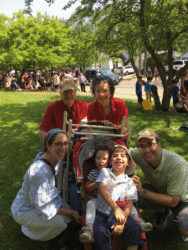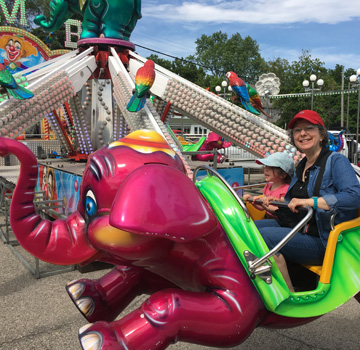
with one of my six grandkids, having a grand time in the air via a pink elephant!
Celebrating My 20 Year Anniversary of CLL
I remember vividly when I was first diagnosed with CLL at age 46. It was July 2001, shortly before our national disaster. At the time, my brand-new oncologist told me that if I was lucky, I might even live for twenty years. Well, I guess I’m lucky, because here I am. And while CLL has definitely been a life-changing diagnosis, it has not been a quickly life-ending diagnosis, as I thought at the time. In 2001, chemo was the first line of action. And the research I looked up did not look promising. The researchers congratulated themselves on increasing survival time from 1 year to 18 months, calling that a fifty-percent improvement. Yikes! And the quality of life for those taking that chemo sure didn’t enhance those extra months, I’m sure. So, I was a terrified skeptic.
Of course, not everyone is dealt the same cards. Some people get their CLL diagnosis when they’re way beyond watch and wait (W&W). With impending threat to life, they ignore the stats and take their chances, and who can blame them! But from what I see on Facebook these days, there are a lot of us on W&W, and this gives us options. Better yet, it gives us time. Time to make a plan and to make changes. Better yet, there are many non-chemo treatments on the market today, some of them even advertised on TV. I’m glad they are available, and at the same time I’m grateful I don’t need that as yet.
To be honest, it took me a couple of years to stop feeling sorry for myself and get started on working on my health. I’ve learned a lot, met a lot of wonderful people, and in what I hope will be a short article I will share my experience.
Step 1: Learning about EDS
My husband and I talked with a stranger on a flight home from North Carolina (I’m in Michigan), and she told us about going to an alternative practitioner who did EDS, a form of electronic screening or testing to see what was wrong with you and what you needed to get well. Because of this conversation, I went to Ellen, a local nutritionist and alternative practitioner. I didn’t much like or believe in the testing. It was way too woo-woo for my taste. But she did suggest that I had a yeast problem, and further that I had to give up bread and all sugars (and my beloved Slurpees. (7Eleven’s frozen Cokes for those who are unaware). I obviously looked horrified as she said I should do that for a week and return.
Here’s where it gets dicey. She tested me again and said I took care of the yeast. Yes, in one week. But now she could see that I had parasites and needed some of her parasite killer bottles of supplements. I declined, and probably went home for a Slurpee. And a sandwich, and maybe a frozen fudge bar. But here’s the kicker. I had no idea that I would eventually be on a much stricter diet than suggested by Ellen. Today I am sugar-free, gluten-free, dairy-free, and worst of all…low oxalate. It’s a miracle I can find something to eat, but as I’m constantly watching my weight, I guess I’ve been able to meet that challenge. 😊
Step 2: Searching for a Cure
I went to various alternative doctors in Metro Detroit, looking for someone who could guide me to good health. Okay, let’s be honest, I was looking for a cure and willing to do just about anything to get there. None of these doctors provided that golden ticket, but one of them sold books in her waiting room. That was where I came across my first helpful book. I’m sorry but I don’t remember the title OR author, and can’t find it in my house. (My husband now uses books to prop things up on occasion, as I mostly read on my Kindle. If I come across it eventually, I will update this post at that time.) The point of this book was that you could ‘control’ cancer with diet and lifestyle. The start of the book recounted a sign in a wildlife park, “Don’t feed the animals,†the reason being the potato chips and twinkies were bad for their health…and therefore, what about us? To this point, at my hematologist’s word, I was still eating what I thought was a healthy diet. The fact that it included frozen Cokes and ice cream cones (quite regularly) hadn’t changed my opinion of my diet. This is where I started to make change.
Step 3: EMF Remediation
In late 2004, my husband was in the local library, reading a natural health magazine. There was an article about EMFs and it’s affect on health, as well as an ad for an EMF detector (gauss meter). We bought one. I started measuring. It turned out that our bedroom (in which we’d slept for 20 years) measured an average of 7mG (milligauss). The WHO (World Health Organization) at the time listed safe levels at anything under 2mG! We measured again with our electric meter box shut down in the basement. It didn’t have ANY effect on the milligauss reading in our bedroom! Creepier yet, the higher you held the Gauss Meter to the ceiling toward the back of the room (closest to the powerline, just about eight feet from our bedroom), the higher the reading. My husband and I didn’t sleep well that night and moved into a guest room.
Long story short, it took five months to remediate the issue. Detroit Edison (now DTE) did not take me seriously at first, but eventually revealed that they had an EMF department! That alone was no help. The EMF department’s goal was to make me feel like a fool. They didn’t talk about danger, but instead about my “comfort†level, like I was a lunatic. For the full story, see my other website, EMFDamage.com.
Step 4: Macrobiotics
Despite my new and improved “anti-cancer diet†(my words), my WBC persisted in climbing. Keep in mind that I was now eating store-bought organic cookies topped with sweetened yogurt. I had a long way to go, but at least I was on the path. There wasn’t much encouragement on the Internet just yet. At the time, a Google search for “cure CLL†(or something like that) brought up a lot of depressing information about chemo treatments and life expectancy. Or, worse yet, end-of-life planning. So I went to the bookstore and started searching for books. I might have even bought some online. One favorite was, I Beat Cancer: 50 People Tell You How They Did It. That led to many other books about the Gerson diet, the Breuss cure, and others. But the one that stood out, spoke to me, if you will, was The Macrobiotic Way, by Michio Kushi, which led to a trip to Western Massachusetts, to the now-defunct Kushi Institute for a week of intensive study of the macrobiotic way, which includes diet, exercise, and lifestyle.
I was on the healing diet for nearly two and a half years. I saw the most improvement in the first month. But at the end of two years, my WBC started to climb back up. Worse yet, I was diagnosed with both anemia and osteoporosis/osteopenia. I started adding animal protein and smoothies to my diet. To this day, both the anemia and osteoporosis remain a challenge. Although I eventually left the diet, many of the principles remain. I eat mostly organic vegetables. I don’t cook at high heat. I don’t have white sugar or white noodles (or any noodles for that matter), I wield a large knife against my wooden cutting board in the kitchen. Even in non-Covid times, I rarely eat out, and buy a minimum of processed foods. I am mindful of my stress level and strive to be calm. My husband had noticed my change of personality. I’m no shrinking violet (I’m not shy!) but I rarely agonize about things over which I have zero control.
Step 5: Laetrile
While I don’t believe that vitamin B-17 (amygdalin, laetrile) is a magic bullet, I consider it to be one of the many pillars holding up my health. But in 2007, I didn’t take it lightly. I’d read Dr. Phillip Binzel’s book, Alive and Well: One Doctor’s Experience with Nutrition in the Treatment of Cancer Patients. This book gave the stories of patients of his that had survived cancer via (in his opinion) the use of B-17. I was thrilled to read that one of the patients had CLL. Like a detective, I tracked her down, and unfortunately, I was able to speak only to her husband as she’d recently passed away. Of course this was sad, and discouraging, but I spoke with her husband at length. He felt certain that her life had been prolonged by Dr. Binzel and his protocol. He also admitted that while his wife took the B-17 and even had it via IV treatment, she found it hard to stick to the diet. Given their experience, I felt this was worth pursuing. Time for another road trip.
My husband and I drove east again, this time to Suffern, New York, to the Schachter Center, where we met with Dr. Jeffrey Kopelson. I’m sorry to say that he died several years ago, suddenly, from a heart attack. While I wanted to have B-17 via IV treatment, he advised against it, as it requires many visits and would have been useless during our three-day stay. Instead, he advised taking 500 mg, 3X/day, starting with one pill a day and working my way up to the full dose. I’ve been taking it ever since, and order mostly from TJSupply.com. I’ve heard good things about ApricotPower as well. Read more HERE about how Laetrile works.
Step 6: Ultraviolet Blood Irradiation
This was probably my most exotic treatment to date. I found a doctor about an hour and half away, near my alma mater, Michigan State University, in East Lansing. At first, I went three times a week, then two, then once a week, then every other. The process is that a technician inserts an IV needle and withdraws a pint of blood into a glass container. Your blood is then returned to your body, via that same IV, once it’s gone through an ultraviolet light machine they have for this purpose. It was painless (except for the first poke) and relaxing, and I met many other interesting cancer patients. I eventually stopped after examining my lab chart. I keep my own spreadsheet. I determined that while I was no worse, I was no better. It wasn’t worth the time and expense. This was my experience, and I know that this works well for other people. So please don’t be discouraged if you’re considering IVBI therapy. It’s definitely worth a try.
Step 7: Patient Heal Thyself
One thing I learned about going for the IVBI treatment was that I didn’t have to go to my hematologist for blood work. As I was so frequently going to E. Lansing, where they were drawing blood anyway, I’d gotten into the habit of getting my CBCs done there. It was so much less stressful than a trip to the hematologist where you had to see the people getting chemo while you waited for your blood draw. I used to dread those visits.
But it was a nuisance to go all the way to East Lansing. My son, then a nutritionist, suggested that I use DirectLabs. You go online and order up your tests. The cost is out of pocket, of course, but not much more than the copays I had at the time. You receive a voucher and locate a participating blood draw location. Today I use Quest locations but have used Labcorp in the past. Your results are emailed directly to you. I don’t recommend this if you’re not familiar with reading your own lab results. Or if you feel the need and reassurance of a medical professional. I do a mixture of both. I see a doctor once a year, and get blood draws every three months. It’s been working for me. I don’t like to be surprised and this keeps me in tune to what’s happening with my body as I continue with my diet and with often changing up supplements. It’s a good idea to check with your doctor to make certain that this is a good plan for you.
Step 8: Living with CLL
There are many with CLL who have reported that they have been totally healed from CLL via natural means. I’ve spoken with three of them, all men. I’ve read about two more. This is wonderful and an inspiration to all of us. It can be done! There is a path, but it is our job to find it. Unfortunately, this has not been my experience. I still most definitely have the diagnosis of CLL. Every blood test proves it.
However, and this is a big however, in some ways it doesn’t matter. I’ve changed up my lifestyle and my diet. I’m ever watchful of my lab work. I eat virtually zero processed foods and nothing (zip,zero,nada) foods made with white sugar. Ever. It’s not even that big of a challenge anymore. It’s just the way I live. But while I’ve been working on this, wonderful things have happened. I’m still here and living my life. I’m still working. I’m still writing and even drawing and illustrating these days. Best of all, I’m still here with my husband and two sons and their families. And as you’ve probably seen, we’ve had six little additions to the family over the last eight years. Six grandchildren! Such an unbelievable blessing! I am grateful every day. If anything has been worth all the work, and all the work to come, it would be this.
Step 9: Sharing
I really left out a step. I believe that it was in 2011 that I started my web site, CLLAlternatives.com. I was worried that I would depress the hell out of people if I died and therefore stopped writing. But it’s been nine years since then, and here I am. Sharing has enabled me to meet and enjoy the friendship of countless CLL Buddies. I keep in touch with people from Ann Arbor (45 minutes away) to London, Spain, Canada, Washington, D.C., New York, California and Florida. There are so many more! Some of these contacts have been fleeting. Many of you I consider to be friends. We are all bound by this terrible and shocking diagnosis that turns into something we can live with. I truly love you all!
As usual, I’m thinking of many more things I could say, but this is long enough. I hope you are inspired to keep on keeping on. Keep up your diet, your lifestyle. Keep testing out supplements and make changes as your health dictates. Check in with your doctor, but also remember that you are the final decision maker of your own health.
Wishing you all the best of health and happiness! – Denise