CLL: My Personal 20th Anniversary

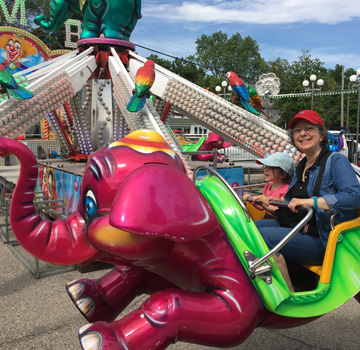
If pigs could fly…or maybe elephants. Here I am
with one of my six grandkids, having a grand time in the air via a pink elephant!

Celebrating My 20 Year Anniversary of CLL

I remember vividly when I was first diagnosed with CLL at age 46. It was July 2001, shortly before our national disaster. At the time, my brand-new oncologist told me that if I was lucky, I might even live for twenty years. Well, I guess I’m lucky, because here I am. And while CLL has definitely been a life-changing diagnosis, it has not been a quickly life-ending diagnosis, as I thought at the time. In 2001, chemo was the first line of action. And the research I looked up did not look promising. The researchers congratulated themselves on increasing survival time from 1 year to 18 months, calling that a fifty-percent improvement. Yikes! And the quality of life for those taking that chemo sure didn’t enhance those extra months, I’m sure. So, I was a terrified skeptic.

Of course, not everyone is dealt the same cards. Some people get their CLL diagnosis when they’re way beyond watch and wait (W&W). With impending threat to life, they ignore the stats and take their chances, and who can blame them! But from what I see on Facebook these days, there are a lot of us on W&W, and this gives us options. Better yet, it gives us time. Time to make a plan and to make changes. Better yet, there are many non-chemo treatments on the market today, some of them even advertised on TV. I’m glad they are available, and at the same time I’m grateful I don’t need that as yet.

To be honest, it took me a couple of years to stop feeling sorry for myself and get started on working on my health. I’ve learned a lot, met a lot of wonderful people, and in what I hope will be a short article I will share my experience.

Step 1: Learning about EDS

My husband and I talked with a stranger on a flight home from North Carolina (I’m in Michigan), and she told us about going to an alternative practitioner who did EDS, a form of electronic screening or testing to see what was wrong with you and what you needed to get well. Because of this conversation, I went to Ellen, a local nutritionist and alternative practitioner. I didn’t much like or believe in the testing. It was way too woo-woo for my taste. But she did suggest that I had a yeast problem, and further that I had to give up bread and all sugars (and my beloved Slurpees. (7Eleven’s frozen Cokes for those who are unaware). I obviously looked horrified as she said I should do that for a week and return.

Here’s where it gets dicey. She tested me again and said I took care of the yeast. Yes, in one week. But now she could see that I had parasites and needed some of her parasite killer bottles of supplements. I declined, and probably went home for a Slurpee. And a sandwich, and maybe a frozen fudge bar. But here’s the kicker. I had no idea that I would eventually be on a much stricter diet than suggested by Ellen. Today I am sugar-free, gluten-free, dairy-free, and worst of all…low oxalate. It’s a miracle I can find something to eat, but as I’m constantly watching my weight, I guess I’ve been able to meet that challenge. 😊

Step 2: Searching for a Cure

I went to various alternative doctors in Metro Detroit, looking for someone who could guide me to good health. Okay, let’s be honest, I was looking for a cure and willing to do just about anything to get there. None of these doctors provided that golden ticket, but one of them sold books in her waiting room. That was where I came across my first helpful book. I’m sorry but I don’t remember the title OR author, and can’t find it in my house. (My husband now uses books to prop things up on occasion, as I mostly read on my Kindle. If I come across it eventually, I will update this post at that time.) The point of this book was that you could ‘control’ cancer with diet and lifestyle. The start of the book recounted a sign in a wildlife park, “Don’t feed the animals,” the reason being the potato chips and twinkies were bad for their health…and therefore, what about us? To this point, at my hematologist’s word, I was still eating what I thought was a healthy diet. The fact that it included frozen Cokes and ice cream cones (quite regularly) hadn’t changed my opinion of my diet. This is where I started to make change.

Step 3: EMF Remediation

In late 2004, my husband was in the local library, reading a natural health magazine. There was an article about EMFs and it’s affect on health, as well as an ad for an EMF detector (gauss meter). We bought one. I started measuring. It turned out that our bedroom (in which we’d slept for 20 years) measured an average of 7mG (milligauss). The WHO (World Health Organization) at the time listed safe levels at anything under 2mG! We measured again with our electric meter box shut down in the basement. It didn’t have ANY effect on the milligauss reading in our bedroom! Creepier yet, the higher you held the Gauss Meter to the ceiling toward the back of the room (closest to the powerline, just about eight feet from our bedroom), the higher the reading. My husband and I didn’t sleep well that night and moved into a guest room.

Long story short, it took five months to remediate the issue. Detroit Edison (now DTE) did not take me seriously at first, but eventually revealed that they had an EMF department! That alone was no help. The EMF department’s goal was to make me feel like a fool. They didn’t talk about danger, but instead about my “comfort” level, like I was a lunatic. For the full story, see my other website, EMFDamage.com.

Step 4: Macrobiotics

 Despite my new and improved “anti-cancer diet” (my words), my WBC persisted in climbing. Keep in mind that I was now eating store-bought organic cookies topped with sweetened yogurt. I had a long way to go, but at least I was on the path. There wasn’t much encouragement on the Internet just yet. At the time, a Google search for “cure CLL” (or something like that) brought up a lot of depressing information about chemo treatments and life expectancy. Or, worse yet, end-of-life planning. So I went to the bookstore and started searching for books. I might have even bought some online. One favorite was, I Beat Cancer: 50 People Tell You How They Did It. That led to many other books about the Gerson diet, the Breuss cure, and others. But the one that stood out, spoke to me, if you will, was The Macrobiotic Way, by Michio Kushi, which led to a trip to Western Massachusetts, to the now-defunct Kushi Institute for a week of intensive study of the macrobiotic way, which includes diet, exercise, and lifestyle.

I was on the healing diet for nearly two and a half years. I saw the most improvement in the first month. But at the end of two years, my WBC started to climb back up. Worse yet, I was diagnosed with both anemia and osteoporosis/osteopenia. I started adding animal protein and smoothies to my diet. To this day, both the anemia and osteoporosis remain a challenge. Although I eventually left the diet, many of the principles remain. I eat mostly organic vegetables. I don’t cook at high heat. I don’t have white sugar or white noodles (or any noodles for that matter), I wield a large knife against my wooden cutting board in the kitchen. Even in non-Covid times, I rarely eat out, and buy a minimum of processed foods. I am mindful of my stress level and strive to be calm. My husband had noticed my change of personality. I’m no shrinking violet (I’m not shy!) but I rarely agonize about things over which I have zero control.

Step 5: Laetrile

While I don’t believe that vitamin B-17 (amygdalin, laetrile) is a magic bullet, I consider it to be one of the many pillars holding up my health. But in 2007, I didn’t take it lightly. I’d read Dr. Phillip Binzel’s book, Alive and Well: One Doctor’s Experience with Nutrition in the Treatment of Cancer Patients. This book gave the stories of patients of his that had survived cancer via (in his opinion) the use of B-17. I was thrilled to read that one of the patients had CLL. Like a detective, I tracked her down, and unfortunately, I was able to speak only to her husband as she’d recently passed away. Of course this was sad, and discouraging, but I spoke with her husband at length. He felt certain that her life had been prolonged by Dr. Binzel and his protocol. He also admitted that while his wife took the B-17 and even had it via IV treatment, she found it hard to stick to the diet. Given their experience, I felt this was worth pursuing. Time for another road trip.

My husband and I drove east again, this time to Suffern, New York, to the Schachter Center, where we met with Dr. Jeffrey Kopelson. I’m sorry to say that he died several years ago, suddenly, from a heart attack. While I wanted to have B-17 via IV treatment, he advised against it, as it requires many visits and would have been useless during our three-day stay. Instead, he advised taking 500 mg, 3X/day, starting with one pill a day and working my way up to the full dose. I’ve been taking it ever since, and order mostly from TJSupply.com. I’ve heard good things about ApricotPower as well. Read more HERE about how Laetrile works.

Step 6: Ultraviolet Blood Irradiation

This was probably my most exotic treatment to date. I found a doctor about an hour and half away, near my alma mater, Michigan State University, in East Lansing. At first, I went three times a week, then two, then once a week, then every other. The process is that a technician inserts an IV needle and withdraws a pint of blood into a glass container. Your blood is then returned to your body, via that same IV, once it’s gone through an ultraviolet light machine they have for this purpose. It was painless (except for the first poke) and relaxing, and I met many other interesting cancer patients. I eventually stopped after examining my lab chart. I keep my own spreadsheet. I determined that while I was no worse, I was no better. It wasn’t worth the time and expense. This was my experience, and I know that this works well for other people. So please don’t be discouraged if you’re considering IVBI therapy. It’s definitely worth a try.

Step 7: Patient Heal Thyself

One thing I learned about going for the IVBI treatment was that I didn’t have to go to my hematologist for blood work. As I was so frequently going to E. Lansing, where they were drawing blood anyway, I’d gotten into the habit of getting my CBCs done there. It was so much less stressful than a trip to the hematologist where you had to see the people getting chemo while you waited for your blood draw. I used to dread those visits.

But it was a nuisance to go all the way to East Lansing. My son, then a nutritionist, suggested that I use DirectLabs. You go online and order up your tests. The cost is out of pocket, of course, but not much more than the copays I had at the time. You receive a voucher and locate a participating blood draw location. Today I use Quest locations but have used Labcorp in the past. Your results are emailed directly to you. I don’t recommend this if you’re not familiar with reading your own lab results. Or if you feel the need and reassurance of a medical professional. I do a mixture of both. I see a doctor once a year, and get blood draws every three months. It’s been working for me. I don’t like to be surprised and this keeps me in tune to what’s happening with my body as I continue with my diet and with often changing up supplements. It’s a good idea to check with your doctor to make certain that this is a good plan for you.

Step 8: Living with CLL

There are many with CLL who have reported that they have been totally healed from CLL via natural means. I’ve spoken with three of them, all men. I’ve read about two more. This is wonderful and an inspiration to all of us. It can be done! There is a path, but it is our job to find it. Unfortunately, this has not been my experience. I still most definitely have the diagnosis of CLL. Every blood test proves it.

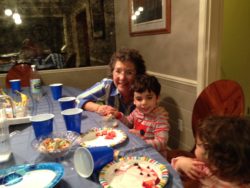
However, and this is a big however, in some ways it doesn’t matter. I’ve changed up my lifestyle and my diet. I’m ever watchful of my lab work. I eat virtually zero processed foods and nothing (zip,zero,nada) foods made with white sugar. Ever. It’s not even that big of a challenge anymore. It’s just the way I live. But while I’ve been working on this, wonderful things have happened.  I’m still here and living my life. I’m still working. I’m still writing and even drawing and illustrating these days. Best of all, I’m still here with my husband and two sons and their families. And as you’ve probably seen, we’ve had six little additions to the family over the last eight years. Six grandchildren! Such an unbelievable blessing! I am grateful every day. If anything has been worth all the work, and all the work to come, it would be this.

Step 9: Sharing

I really left out a step. I believe that it was in 2011 that I started my web site, CLLAlternatives.com. I was worried that I would depress the hell out of people if I died and therefore stopped writing. But it’s been nine years since then, and here I am. Sharing has enabled me to meet and enjoy the friendship of countless CLL Buddies. I keep in touch with people from Ann Arbor (45 minutes away) to London, Spain, Canada, Washington, D.C., New York, California and Florida. There are so many more! Some of these contacts have been fleeting. Many of you I consider to be friends. We are all bound by this terrible and shocking diagnosis that turns into something we can live with. I truly love you all!

As usual, I’m thinking of many more things I could say, but this is long enough. I hope you are inspired to keep on keeping on. Keep up your diet, your lifestyle. Keep testing out supplements and make changes as your health dictates.  Check in with your doctor, but also remember that you are the final decision maker of your own health.

Wishing you all the best of health and happiness! – Denise
Living Well with CLL —
the Movie Part 1

If you’re interested in more CLL alternative health videos, here is video #1. (I know, I know, this is my second posting of a CLL video; I posted out of order. Please forgive my inexperience at becoming a movie “professional.”) In this movie, I introduce Teresa, who came with her husband, Keith, to visit us in Michigan. I took advantage of the opportunity to record our conversations. Teresa told me she had a lot of questions, and I thought it was a good idea to share those questions online. It turns out that Teresa also has a lot of good ideas to share, even though she’s only be at it for a few months. I am impressed… and grateful for this new connection. And please return again and again as I continue to figure out how to make these videos! 🙂


New CLL Alternatives Video

I made a series of videos with Teresa, a CLL buddy I met through this site — and who was visiting the state for her son’s graduation. This is the first of what will be many videos from this meeting. I hope you get some good information from it.  It took me some time to figure out the iMovie software. It turns out that it’s easiest to edit and create the video on my iphone — and also to upload it to youtube the same way. Another (funny) fact…the best how-to videos about how to make DIY movies are on youtube and made by kids! 

Out of the Closet: When to Tell Friends and Family about a CLL Diagnosis

For whatever reason, when I was first diagnosed with chronic lymphocytic leukemia by my original hematologist, he advised that I keep the news to myself.
“It’s stage zero. You have no symptoms; you look healthy. So there’s really no reason to tell everyone you know—unless you want to.”

Unless you want to.

I had no idea what I wanted. I honestly didn’t even believe I really had CLL until my follow-up visit. I was totally expecting them to test my blood and apologize for their mistake. And I knew what I would say to that. “Thank you! God bless you! No harm, no foul.” And most of all… “Good bye!”

Of course, that didn’t happen.

But back to the issue of what and when to tell people. Now that it’s been sixteen years, as of this writing, I’ve learned that most people tell everyone everything. From day one.

But not me. I told my immediate family and one special friend and her husband. I could tell by her husband’s response that he felt like he was talking to a doomed woman. At that moment I knew what I wanted, and that’s what I did for nearly fifteen years.

I told no one.

I felt safe in my anonymity. I told myself I would share my story when I started chemo. At the time, I was positive chemo was inevitable. In 2001 if you look up “CLL” or “chronic lymphocytic leukemia” on Google, the news was not good. It was all about the Rai or Binet stages. And while I was low on both, all the attending information was not encouraging. Even the brochure from the hematologist was a colossal downer. The last section was about end-of-life decisions. How’s that for encouragement?

I didn’t want everyone to think of me as a dead woman, so I kept my mouth shut and swore my family to secrecy. I kept it that way for a long, long time. For years, actually.

It wasn’t until November 2011 that I started CLL Alternatives.com at the urging of my husband. He said it was time to share my story with other people. I wasn’t keen on that idea because I wasn’t ‘cured’ yet and, at the time, that was my personal benchmark. I wanted to be cancer free.

The reason for this benchmark: I’d been reading a site by a man with CLL who was trying just about every alternative under the sun, including artemisinin. Unfortunately, his final entry was a farewell post. His CLL was fatal, his body was riddled with cancer, and he didn’t have anything to add to his site. I was horrified. For him. For myself. I didn’t want to start a site to do that to others.

But still…by 2011 I was already ten years into this thing and it appeared I wasn’t about to sign off just yet. Not only that, I’d been actively researching and trying out alternatives and changing my lifestyle—and seeing results! So I felt I did, in fact, have something to share. So I started my web site, bringing me out of the closet, albeit anonymously. And ironically.

But slowly, some time around 2013, I started telling friends, one at a time. At first it made me uneasy, as if telling my tale would somehow make it more real. And lethal. But things had changed since 2001. A lot of people I knew were living with cancer. It wasn’t quite the sudden and immediate death sentence it had been.

So I told more friends, one by one, especially and always those who had or were close to someone who had a diagnosis. At this point, it couldn’t make the diagnosis any more real than it already was. And it certainly didn’t make the course of the disease any worse. In fact, by 2013, my WBC (white blood count) started to drop as a result of starting a raw food/low temperature-cooked food diet.

At the time of this writing, after sixteen years of living with a CLL diagnosis, I believe I’m out of the closet. I’m Denise and I have a CLL Diagnosis. Here is an important point: because of Hessel Baartse’s web site and story, I’ve learned to refuse to say that I “have CLL.” No. Instead I say I have a “CLL diagnosis.” This separates me from the illness, and I enjoy every degree of separation!

So what should you do if you are newly diagnosed? To tell or not to tell? My answer: it’s entirely up to you. I’d go with whatever feels right. For me, I needed the cushion of years—and wellness—before I could share my story with my in-person friends. I’m so glad my husband encouraged me to start CLLAlternatives.com because I’ve made so many friends, and so many valuable connections. And if I’ve helped a lot of people along the way, well, that’s kind of the point.

Alive and Well with CLL — 14.5 years now and counting…

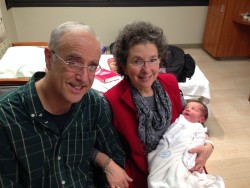
Me and Peter with brand new grandson.

I’ve been so busy with my life lately, that I’ve neglected posting here on my CLL web site. The good news is that I’m doing well! My numbers have been improving. I’m stable, and therefore have been able to concentrate on other things in my life: like my work and my grandkids. (Jared, pictured at left, is our fourth grandchild. When diagnosed in 2001, I didn’t know that I’d be blessed to live long enough to see our sons marry and have children.) However, sharing my CLL experience is so important to me. I’m doing well and it’s not by accident. It’s not “spontaneous,” even though that is how a conventional doctor might describe my condition. It might not be “spontaneous remission,” but instead “spontaneous improvement.”

There is so much I’ve done, and so many changes I’ve made, that it will take many, many posts to share everything there is that you can do to try and improve your health. I believe that a lot of what I’m doing would benefit anyone with any kind of cancer—not just blood cancers, and certainly not just CLL.

Unfortunately, there is no one-size-fits-all breakthrough. Not in the conventional medical world. And not in the alternative world. However, (this is a BIG however), the alternatives don’t hurt you. They may be more difficult and require more effort and commitment, but they will cause no harm.

Here is a quick laundry list of my changes:

1. I never eat burnt food or any food cooked at too high a temperature.

2. I stick mainly to organic food, whenever possible.

3. I eat out once or twice a week, tops. This means I take my lunch to work. (I don’t consider this a hardship anymore, but a pleasure.)

3. I ferment my own vegetables, and eat them at each meal, at least a little bit.

4. I drink filtered water and organic herbal tea (specifically raspberry leaf tea, as it doesn’t leach iron and I tend to be anemic).

5. I have a whole orange about 5X/week in my smoothie. By “whole,” I mean the peel and the pith (the white part). The pith contains d-limonene, which is anti-leukemic.

6. I drink a cup of home-made bone-broth soup nearly every day. Several sources have recommended bone broth for leukemia and other blood cancers and disorders.

7. I exercise 5X/week for 15 minutes. On an elliptical, a rebounder (trampoline) and with weights. I’m not an athlete, but still pretty fit for a 60-year old.

8. I get sleep at night!!! It feels wonderful. I shoot for going to bed at 10, and get into bed by 1030 or 11 each night. Since taking a new pill (for my hair, prescribed by an alternative doctor), I’ve been sleeping like a baby. Okay, I’ll amend that: I sleep like a baby without colic. : )

There is probably more, but I’m writing at the top of my head right now. Each of these eight items could be it’s own blog post. And I’ve been asked by my CLL-buddies who write to me to please post some recipes. And I will. I promise. It all takes time and I’m delighted to say that I have a busy (and pretty healthy!) life. But this matters to me. YOU matter to me. So I promise I will get on with it and keep posting.

If you’d like to be one of my CLL-buddies, please write me at cllalternatives @ gmail.com (with no spaces — those are for the mail-bots). And please feel free to post on this article and on this site, because the more we share, the more we help even more of us struggling with CLL.

Apricot Seeds and CLL Leukemia

Apricot Seeds
My shrink-wrapped apricot seeds, coffee grinder and the pills I made from them.

Like Wayne, an Oklahoman I met via the Internet, I have have both CLL leukemia AND diverticulosis.  I’ve never been officially diagnosed with diverticulosis, but every time I eat nuts or seeds whole, I suffer.  Sometimes for days.

It’s not the chemical composition of the nuts and seeds.  I know this because when I grind them into dust (flaxseeds) or buy them already ground into paste (almond butter) I can eat them with wild abandon — and no after effects.

Part of my good health program started in 2007 when I started taking amygdalin pills from Mexico, along with enzymes and other supplements.  I was advised to also eat the apricot seeds — in addition to the pills.  I tried this twice early on in 2007 and 2008.  Both times I suffered severe stomach upset.  For days.

But after speaking to Wayne in Oklahoma for the third time, my husband encouraged me to buy a pill making device and grind my own apricot seeds in our coffee grinder (Mr Coffee brand, available everywhere).  I’ve been doing this for just a few months.  My last doctor visit showed  a marked improvement in my WBC (from 32 down to 23… yay!)  But those numbers do tend to bounce around.  I will report back after my next visit.

The general way to take amygdalin, B-17, laetrile (all pretty much the same thing) is: if you have cancer of any kind, it is generally recommended to work your way up to three 500mg tablets/day, one at each meal — in addition to eating the apricot seeds.  Once again, it is recommended to take one seed for every ten pounds of weight, each day.  I personally grind my seeds and then put them into capsules with the help of a pillmaker I found online, but many people are able to eat the seeds whole. (The taste of the seeds is not great — another incentive to grind and make into pills!)

Please note that I am not a doctor — and that I am giving information about what works for me, personally. If this intrigues you, first go to WorldWithoutCancer.uk.org and learn all you can about it.   I wholly recommend that you research and try things for yourself — carefully and safely.  Not to mention seeking out the advice of a health care practitioner who is familiar with vitamin B17.  I found my doctor on cancure.org.  He isn’t local — but I think it was well worth the trip!

CLL and Green Tea

Green Tea for CLL
You can drink green tea for health benefits, but therapeutic use requires a green tea extract, taken as a supplement.

There is a lot of literature out there about CLL leukemia and green tea.  Go ahead and Google “CLL green tea” and you will come up with pages of references.  Green tea is supposed to halt the progression of CLL and, in some cases, improve symptoms.  That’s wonderful.  The good part of this is that it’s a food item (when taken as tea) and a food extract when taken as a supplement.  If you’re interested in a good quality, green tea extract, go to Life Extension.

Do I use it?  Yes and no.  I do drink green tea, practically every day. But not in therapeutic doses.  That’s because, in my case, my platelet count dropped noticeably each time I tried it at recommended levels.  Worse yet, there was no discernible benefit.  The studies I’ve looked up indicate that green tea does, in fact, affect the “aggregation” or clumping together of platelets — a good thing for people with heart disease.  While I can find no literature to back up my experience, it is what it is.  I do reserve the right to try green tea in therapeutic doses (beverage AND supplements) in the future.  But for now, I’m sticking to my already very-full and somewhat complicated program for good health.

If you want more information, you might take a look at the Mayo Clinic study in progress till March 2011.


CLL Alternative Protocol

Here is the list of what I take and what I do, at this time in my life (it has changed many times) to be well and get well.  My goal is, and had been, since July 2005, to become cancer-free.  Others have done it and so can I.  (By implication, you can too!) There is no one path.  Unfortunately, we all have to find our own formula.  While that sounds daunting, to me it’s a heck of a lot better than counting on one professional who will give you fifteen minutes of his or her time, each visit.  You can give yourself as much time as you need!  Be your own health care advocate, and you can spend an hour or more EVERY DAY on yourself.  There isn’t a doctor alive — conventional or alternative — who can do that for you.  You can only do that for yourself.

Between Meals
(before breakfast, mid-afternoon, before bed)

  • Univase Forte enzymes, 6 total,  2 pills/3X a day
  • Apricot Seed pills (grind and make myself) 4 pills, 3X/day btw. meals
  • Natural Thyroid 60mg, 1X, 1/2hour prior to breakfast
  • Wheatgrass Juice (I grow and juice my own) 4-5 ounces, every morning 1/2 hour before breakfast
  • Low Dose Naltrexone 4.5mg, before bedtime

Breakfast


  • Actifolate 800 mcg
  • Magnesium 200mg
  • B Complex 1 pill
  • Black Currant Seed Oil 1000mg total – 2softgel
  • B-17 Laetrile 500mg
  • Vit C 1000mg
  • Bioflavinoid 1000 mg
  • Vit E 200 IU softgel
  • D3 1000 IU softgel
  • CoQ10 50 mg ubiquinol (not ubiquinone)
  • Primrose Oil 1300 mg softgel
  • Calcium 250 mg
  • Probiotic 1 gram 20 bill organisms, 12 strains
  • Broccoprotect 1
  • Regenemax (5mg silicon) 1
  • Reduced Glutathione 300 mg
  • Iron Pill (Iron Glycinate) 29mg, 4X/WEEK (every other day)

Lunch

  • Vit D3 1600 to 2000 IU dry (Twinlabs Allergy D)
  • Potassium 99mg
  • CoQ10 50 mg unbiquinol (not ubiquinone)
  • Zinc Asporotate 15mg
  • Iodoral 25mg
  • B-17 Laetrile 500mg
  • Selenium 200 mcg
  • Grapeseed Extract (every day @ lunch, one month on, one month off)


Dinner


  • Magnesium 200 mg
  • B-17 Laetrile 500 mg
  • Fish Oil 1000 mg (Omega 3,5,6,7,9)
  • Curcumin 665mg
  • CoQ10 50mg unbiquinol (not ubiquinone)
  • Vit D3 1000 IU softgel
  • Primrose Oil 1300 mg
  • Calcium 250 mg
  • Joint Ease (glucosamine 250mg, chondroitin 250mg, queritin 250mg, taurine 250mg)
  • Vit K2 100 mcg (bone health)


Immune-Boosting Butter
1tablespoon/day (more if I want an extra immune boost)
Recipe:

  • 1 stick room temp organic butter
  • 1/2 cup organic cold-pressed virgin olive oil
  • 10 capsules probiotic
  • 10 capsules colostrum
  • 6 capsules l glutamine
  • 1 tablespoon raw honey (local)

Empty capsules into a bowl.  Add olive oil, butter and honey.  Blend with immersion blender (that’s what I use).  Cover and refrigerate.

D’Mannose
I use this, as needed for UTIs (urinary tract infections).  This has been, quite possibly, a life saver.  While I still carry a prescription for antibiotic in my wallet, I rarely, if ever, use it.  This deserves a page of its own.

Diet

  • NO sugar
  • NO gluten
  • NO white bread
  • NO refined salt
  • NO processed foods
  • NO store-bought baked goods
  • NO nuts or seeds (unless powder-fine or smooth paste

What I DO eat:

  • YES Organic greens
  • YES Organic vegetables
  • YES Organic fruit (small amount/day)
  • YES Organic grass fed beef
  • YES Organic poultry
  • YES Organic free-range eggs
  • YES Wild-caught salmon and other fish
  • YES Organic olive oils and other oils
  • YES Sprouted lentils, grains
  • YES Almond butter
  • YES Rice Cakes
  • YES Oatmeal
  • YES Organic butter
  • YES Raw milk yogurt
  • YES Greens/Fruit Juice in my Vitamix

It IS hard to eat out, but I manage.  I mostly try to limit eating out of the home to two times a week (total, includes lunch AND dinner).

Exercise
I walk my dogs every day. I exercise for 15 minutes 3X/week on our elliptical trainer.  I lift weights 3X/week for my osteoporosis and heart health.  I can now run up a flight or two of steps without getting overly winded.  Couldn’t do that 10 years ago.  It pays to exercise!

Sleep
My goal is to be in bed by 10pm, and to get at least 8 hours of sleep each night.  I feel wonderful when I achieve this goal.  I’ve read again and again that the sleep before midnight is the best healing sleep. It makes sense.  Try this.  It is one of the best things you can do for your immune system and your health.  It’s free -  and you can feel the results literally overnight.

Mindset
Don’t worry.  Be happy. I know they have studies to prove it, but who need studies?  We all know we feel like crap when we stress out and worry.  Racing pulse.  Palpitations.  Bile in mouth.  How good can that be for you?  The experts tell us to meditate.  I’ve tried it, and it always feels weird to me.  I prefer writing in my journal or reading something relaxing.  Either one gets me away from myself, and helps me to relax and stop stressing.

That’s it for now.  I think that you can see that it takes a lot of time, effort, not to mention cash, to take care of yourself.  Whatever I’m doing is infinitely less expensive than chemo treatments.  None of it has side effects.  And I feel great.  Please write with any questions.

Due to an unreasonable amount of SPAM, I suggest that you email me at info(at)cllalternatives.com if you can’t seem to get a comment posted.

Getting Well from CLL Leukemia

CLL Success Stories. There are two success stories, so far, both men, who have overcome their CLL Leukemia and either achieved remission  — or became cancer free! — without conventional treatment.  We can think of this as a miracle (which it is) or a sign of possibility and hope (which it is too!).

I was first elated to hear the news that these people exist — and then a bit deflated when their methods did not work for me.  I tried all or parts of each of their personal protocols, but to my severe frustration, it hasn’t yet resulted in my remission.  That said, I haven’t given up.  There is still a message of hope and possibility.

The first CLL Leukemia success story I found was Steve Freier.  You can read his whole story by clicking on his name and going to his site.  After a short-lived unsuccessful conventional treatment, Steve tried several protocols and eventually reached remission after removing his root canals and taking coral calcium.

The second CLL Leukemia success story is Hessel Baartse.  Once again, click on his name and read his miraculous story.  Hessel reached health with the help of a dentist (he also had his root canals — and mercury fillings — removed), as well as a detailed diet and supplement regimen.  All his CLL markers are in the normal range, and he is living his life in Australia with his wife and family.  If you read his site, you will see that Hessel credits his faith in God and his belief in his own good health.

CLL and Root Canals. What they both obviously have in common is that they removed their root canals.  I will be writing another article about this, as I, too, have had that surgery done to improve my health.  I’ve also followed both their regimens, plus much, much more.  I may not be cancer-free, but I am healthy and well — after 9.5 years (now, at the time of the update of this post, it’s been 14 years!), with no conventional intervention.

It can be done!  What we can learn from Steve and Hessel is that it can be done!  We can all get well.  We just have to find our own way, our own combination of diet, exercise, herbs, supplements, and even drugs.  There is no set standard of therapy, even amongst conventional doctors.  Humans are NOT one size fits all — in clothing or in medical treatment.

So please read this site, as I add more and more information.  Check out the links.  Do some research of your own.  Keep a positive attitude (easier said than done, but do-able) and you will prevail!  If you have good news and/or information please write and share it with this site.


CLL Leukemia Diagnosis: Overcoming the Fear

fear

Now that it’s been over nine years since my diagnosis of CLL leukemia, I have to say that my mental state is quantifiably better than it was July 2001, when I first had to deal with it.  It helps enormously that I am still stage one, and have remained “steady” without the help of any conventional therapies.  Not a drop of chemo.  No prednisone.  This despite many harrowing brushes with low platelets, dropping red counts, rising white counts, hematuria (blood in urine) and other freak-out factors.

Like many CLL diagnosis “victims,” I experienced sadness, grieving, easy tears, insomnia, and morbid thoughts. At one point, I even started thinking carefully before investing in something lasting like, say, a leather coat.  It might be “wasteful,” I thought at the time.  After all, I wasn’t sure how many seasons I’d be around to enjoy it.  I was overcome by negative thoughts and FEAR.  Fear of dying.  Fear of death.  Fear of leaving my family behind.  This made me overwhelmingly sad.

How I overcame fear: Action! Once I realized that I could not and would not count on medical doctors to keep me alive, this truth set me free.  Once I started to take charge of my health, doing all the things you can read about on this site (and elsewhere), my mindset changed.  It started with my macrobiotic diet (which I ironically no longer follow) that I felt a sense of calm and peace.  I started to know in my heart that I was going to be fine.  I was planning to live.  That was in 2005.  It is now nearly the end of 2010 and I’m still here, living my life, doing what I have to do to be well.  But I am also quietly and calmly confident that I am going to be “here” for a long time.

The first step to wellness. So if you are depressed, worried, fearful, or in any way devastated about your CLL leukemia diagnosis (or that of a loved one), take heart!  You don’t have to curl up into a ball of worry.  There are things that you can do.  The more things you try (and measure with frequent blood tests) the better your chance to prevail.  Saying goodbye to fear is your first step on the road to wellness.

Due to an unreasonable amount of SPAM, I suggest that you email me at info(at)cllalternatives.com if you can’t seem to get a comment posted.