Intermittent fasting has become quite the craze. Google it and you will see countless pages, including many youtube.com videos touting its safety and effectiveness. I agree…to a point. It turns out I’ve been intermittent fasting for years – but didn’t realize it. Does that sound crazy? Let me explain.
Before I started a truly healthy non-SAD (standard American diet), I would be ravenous for breakfast. I remember standing in the shower with true stomach PAIN gripping my being. I would speed dress and run to the kitchen for relief. Yes, relief. I wasn’t just hungry; I was crazy hungry. I believe the reason was sugar, and probably gluten. My standard breakfast at the time was a bowl or two of cereal, sometimes topped with bananas. At the time, I thought it was a pretty darn healthy diet.
Cut out the sugar and enjoy your morning calm. It wasn’t until I read Beating Cancer with Nutrition by Patrick Quillin and started cutting out most processed foods that I felt a difference. This difference became even more pronounced when I went on the Macrobiotic diet as taught by the now-defunct Kushi Institute in Becket, Massachusetts. At the Institute, they had morning exercises prior to breakfast. Before my Quillin-inspired diet, and the fare I was eating at the Institute, there was no way I could have made it through exercise class. I would have hopped in my car in a mad search for a restaurant or a supermarket. But I felt the change. Waiting was no problem, and neither were the gentle stretches and exercise. I’d already begun my Intermittent fasting; I just had no idea that was what I was doing. This was 2005.
I’m already intermittent fasting! In fact, it wasn’t until I recently (this is September 2018) listened to a Nasha Winters youtube.com video that I realized I’m an Intermittent faster! Dr. Winters said that fasting for a mere thirteen hours was enough to prevent breast cancer. Thirteen hours! I generally fast for fifteen! I will explain.
The hours of fasting include sleep. For me, this is about seven hours on a good night. The rule is to not recline or go to bed for at least three hours after eating. No problem. I’m usually done eating by 7:00 pm, and rarely make it to bed by 10:00 pm (even though that’s my target bedtime). Even if I set the clock for 6:00 am, which I generally do, I’m rarely out of the house till 9:00 or 9:30 am, and I let myself have my morning smoothie at 10:00 am or later, when I’m at my desk, ready to work. (I often have some sauerkraut or pickles at about 8:00 am, and a cup of bone broth soup at around 9:00 am. According to the experts, these “treats†don’t count. If you haven’t had sugar or carbs, you are still in IF.) The last time I checked, 7:00 pm till 10:00 am is fifteen hours. And I often go longer than that. Without any struggling.
Is this the reason for my continued good health? The point is that I’m doing well, or at least well enough. I’m seventeen years into this CLL gig, and my numbers are similar to what they were at diagnosis. (Please note: I still most definitely would be diagnosed with CLL if I went to any doctor for the first time. I’m NOT cured, but I certainly am a well and healthy human being!) The short answer to this question is: yes, but. Yes, it is part of why I’m doing well, but it is most certainly not the only reason. There are also the large issues of diet, supplementation, exercise, sleep, clean water and air, and the general avoidance of toxins.
So how does IF work? Yes, this is an important question. Our bodies are complex and busy machines. We all know that we heal best overnight. When we’ve suffered a cut or minor injury, we often find it at least partially healed in the morning. When we have the flu or other minor illness, there is nothing quite like a good night’s sleep to help us recover. Our bodies are designed to heal. When we are at rest, our internal machinery is busy at work, our immune systems on high alert, clearing out the toxins we’ve come across, kicking out the pathogens (germs), rebuilding damaged tissue, and so on. While it’s not a cure for CLL, it is certainly one of your major pillars of health. It’s a wonderful system, but there is a hitch.
If we’re loaded up with food, the body must divert its energy and attention to plain old garden variety digestion. What a waste of energy and time! This is why it’s vital to stop eating a good three hours or more before bedtime. Your digestive system will have had plenty of time to work on its latest load of nutrients, giving the immune and reparative systems what they need to help heal your body. It’s a beautiful system. Don’t muck it up with late-night snacks. Water or herbal tea is fine. Stay away from caffeine; your body doesn’t do this repair function nearly as well when you are awake.
Intermittent Fasting Side Effects. It’s all good. IF can improve your heart health, suppress inflammation, fight free radical damage, and more. In general, it’s just plain good for your overall health. While many use this method of eating to lose weight, that has not been my experience. Read more about IF in this article by Dr. Joseph Mercola.
Check out your eating schedule. If you’re already cut out the sugar and glutens, chances are you’re not starved all the time, and eating day and night. You might already be intermittent fasting. It might be that you’re close, but still eating a late-night snack. It’s hard to make those changes. But now that you know about the mechanism of self-repair and healing, perhaps you’ll find it worth your while to try.
[Please note: my husband (who I adore) pushes himself and pushes me to be my best. He nagged me (sorry, but that’s the most accurate word) to keep my hours between 5:00 or 6:00 pm at the latest and 11:00 am or 12:00 noon at the earliest. When I tried to meet this eating schedule I developed stomach issues. To be specific, stomach pain while sleeping that kept me up many nights. It turned out, on self-reflection, that I was rushing through dinner to get enough ‘fasting’ hours in. And I was famished by 11:30 am and didn’t eat slowly or mindfully. In other words, I was stuffing my face, quickly, all during my ‘feasting’ hours, and it was hurting my health.]
Pay attention to your body. Maybe thirteen hours is your limit. Maybe twelve. The important thing is to go to bed on an empty stomach, and then to delay breakfast for as long as reasonably comfortable.
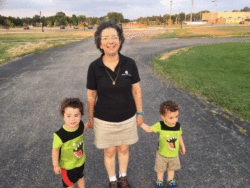
PS: If you wonder why I always post photos of my grandchildren…it’s because when first diagnosed I really didn’t believe I’d live to see weddings, let alone grandchildren. It’s a joy in my life and I’m grateful for my extra years. I wish them for you as well!