CLL Personal Care Products

Personal care products for CLL
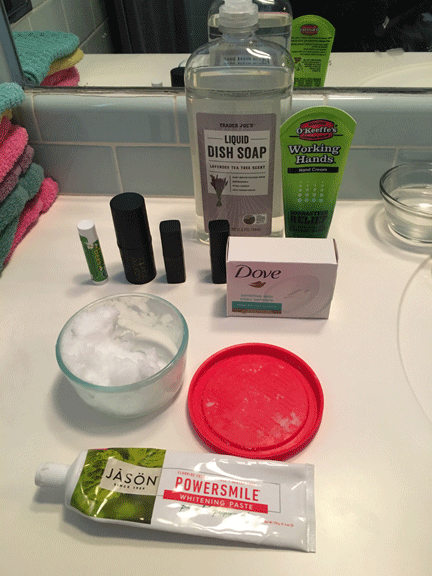
Some of my personal care items.

Today I’d like to talk about personal care products and how using the right things can absolutely help your immune system keep  your CLL symptoms and progression at bay. Here, in simple terms, is the theory behind it, in case you or a loved person is new to fighting leukemia or cancer. Our immune systems have a big 24/7 job. The first purpose of the immune system is to fight off pathogens, things like bacteria, virus, fungus and the like. When your immune system is instead clearing toxic matter out of your body, it overloads the system and makes it harder for you to fight off colds…and leukemia. So give your body a break!

In modern times, our immune systems are also tasked with fighting off toxics and other nasty things in the environment. So if you’re spraying your home with pesticide because you’re not fond of spiders or flies (or some other pest), you are putting a burden on your immune system, which has to make an effort to clear the toxins out of your body. Some of the toxins, like pesticides, are obvious. 

Other toxins are more subtle and hidden in your self-care products, like your toothpaste and shampoos. Always look at the ingredients on the label. If there are things you cannot pronounce, chances are it’s not a good choice. Too many chemicals!

I would recommend going organic, but that is really not enough. Unless you are familiar with a particular manufacturer and know that their products are ‘clean,’ that is free from toxic ingredients, I suggest you check it out with EWG.org (the Environmental Working Group). This organization tests products and rates them on their website. This is an invaluable tool for preserving your health! 

So what do I use? What are my habits. I will share.

Face and body cream.

I use good old-fashioned coconut oil. Yes! I buy the organic tubs at Costco and transfer a small amount into a glass container which I keep in the bathroom. It’s called ‘oil,’ but if you live in Michigan or other northern climes, it’s really more of a chalky oily paste until we’re experiencing deep summer. The trick of using it is to take about a half finger-tip of from the container and warm it between your palms, where it will melt into oil. Then spread onto the backs of your hands and then onto your face and body. Make sure your hands are clean when you start this process. 

The ingredients here are one. Coconut oil, and organic coconut oil at that. No need to look this one up on EWG.org. If this doesn’t appeal to you, go to your local health food store or order online your choice of organic oils, such as avocado, jojoba, almond, etc., etc. I used to do that, too, but I’ve learned to love coconut!

Hand Cream.

Yes, in Michigan winters this can be a separate category. When coconut oil isn’t enough, I use O’Keefe’s Working Hands. Yes, it passes the EWG.org smell test and it works! When my hands start getting rough I apply at bed time, when there are a few hours before my hands will be in water. If I wait too long and my fingers start to crack (ouch!), I apply the Sierra Bees lip balm on the finger cracks. Instant relief and it helps it heal. Once again, night time is best for me, as I am a compulsive hand washer.

Toothpaste.

There are people who make their own, and I encourage you, if you are so inclined to look up recipes for home-made. That said, while I spend a LOT of time on my personal care and health, making toothpaste is not my choice. Instead I’ve been using Jasen’s Powersmile. It works well, tastes great, and I’m getting good dental check-ups. Several times a week I wet my tootbrush with plain old peroxide before adding the toothpaste. Over time, it has whitened my teeth, with no toxic effect!

Soap.

I use Dove brand scent-free soap for ‘sensitive skin.’ I tried the organic type made locally by a dedicated organic soap maker, but…over time my plumbing got clogged with the cement created by rinsing my hands in the sink. (Have I mentioned that I wash my hands a lot, maybe too much?) I was told since then that if you use both the organic soap AND conventional soap, the chemical reaction in your plumbing creates the problem we had. So I reverted to my Dove soap. It doesn’t seem to hurt my numbers at all. 

Dishwash Liquid.

This one I scout around and buy the brands that have no chemically ingredients. My current favorite is Trader Joe’s Lavendar and Tea Tree scented soap. While it doesn’t totally pass the smell test of ingredients, at least the ingredients are listed! On a Palmolive dish soap my husband bought one time, the only reference to ingredients was “no unnecessary ingredients.” I would have preferred a listing, and haven’t bought it since. Keep in mind…dishwash soap is not applied directly to your skin like hand cream. Still, it’s best to limit your contact with these potentially toxic chemicals. 

Fragrances.

I’ve always been allergic to perfume so, so much for that. But, that said, watch out for fragrances in other personal care products. If you check things out in EWG.org, you might notice that the fragrances added to personal care products, soap included, are toxic! If a natural/organic product has lavender, tea tree oil, or other true scent added (as opposed to a chemical substitute), leave this product on the shelf and make another choice. This goes for liquid hand soaps and bathroom spray! (The best bathroom spray is an open window!! Just saying.) 

Makeup.

Well, I don’t wear much, even though sometimes I think I should (but not for health reasons J). I use Ecco Bella and Suzanne Sommers products, and for lip gloss I use Sierra Bees (which I find on iherb.com.) Once again, whatever your choice, run it through the EWG.org app either on your desktop or on your phone. Check before you buy!

Shampoo and Conditioner.

Okay, I have difficult-to-deal-with, unruly, prone-to-frizz curly hair. Nothing but the Deva Curl products (not organic) make my hair look okay enough to make me happy. Happiness matters. However, I do get my bloodwork done regularly and if it were a choice between acceptable hair and my life, LIFE would win every time. This product/manufacturer touts that they do not include sulfates, parabens or silicone. This is nice, but they also include many ingredients I cannot pronounce and I’m afraid to look up. This is a conscious choice. I’m pretty much an annoyingly goody-goody Girl Scout when it comes to my health habits. This is my one questionable habit that is always up for change. But thankfully, so far, so good.

Before I sign off, I would like to apologize for waiting so long between posts about CLL! I’m alive and well, in case any who returns to this site from time to time was concerned. The reason for my absence is many. But one main concern of mine is that I felt this site was being sidelined in the search engines, particularly by the big one who (starts with a G and) will not be named.  More than one of you wrote to tell me that this is not true. That my words do in fact reach people who can be encouraged and helped by what I share. So I’m back!

In addition to grandchild number six (who knew! I only have two sons!) I’ve been busy working at my regular job and also on what is probably a less important site that is near and dear to my heart. Perhaps one day I will link to it on this site, which is in great need of updating. All in good time.

If you have any personal care product recipes or product suggestions, please share. I’d love to hear from you! 

Wishing you the best of health and a nice, long life! – Denise
CLL: Facing the Fear and Loneliness

I just answered an email from a CLL-buddy who is feeling the fear and loneliness of a CLL diagnosis. She does not want to burden her husband by dwelling on her dark thoughts and worries about CLL, and her friends don’t seem to be any comfort. Of course not! This worries them too, and while they wouldn’t say it to her, knowing that a friend has a potentially fatal diagnosis makes them worry about their own lives, as well as about their friend. So what is a person to do? This was my answer to her:

Dear CLL Buddy,
I do understand how difficult it is to keep a happy face on this when you are so frightened. Eventually, you will feel confidence in yourself and in your health, and you won’t feel so frightened. Believe me, you are not alone in having fear of CLL! Here are a few suggestions that have worked for me.

1. Allow yourself to be frightened or upset for only one day at a time, particularly after a blood test that wasn’t what you wanted.

2. Research. The next day, concentrate on the blood marker that concerns you, and start some research on what you can do about it. Look up supplements and herbs. Make a lifestyle change, etc.

3. Have fun! Find time every day to do something you enjoy that is relaxing and gets your mind off of CLL! Read a book, go to a funny movie, visit with a friend (and not talk about CLL) maybe shopping or an art museum or something that you find fun (and gets your mind off the CLL).

4. Find your own personal meditation. I’ve tried meditation tapes (now they would be CDs or better yet, mp3s). This wasn’t for me, but many people find relief in this. My personal meditation is reading novels or writing, or even drawing. I have sketch books, and I find that when I’m sketching, I’m not thinking of anything but the pencil and sketchbook. I lose track of time. It is wonderful! Think back to childhood and what you enjoyed doing that made you lose track of time. Give yourself a gift of figuring this out, and then act on it!

5. Get a good night’s sleep. Make your bedroom light-proof so you can get a good sleep at night and make your own melatonin. Nothing makes you feel better than a good night’s sleep!

6. A new watchword: you are NOT about to explode! Any doctor that would see you today would send you home and then go about his or her business. You are not in imminent danger! Enjoy today! None of us know if there is a tomorrow (we get hit by the bus, etc., who knows?) So why waste today? Enjoy it! It is a gift you are squandering on worry.

7. Recognize that you can gain control of your health. It wasn’t until I became Macrobiotic (ironically, I am no longer macrobiotic, but still…) that I started to see the control I could exert over my CLL diagnosis. After one month of giving up all processed foods back in 2005, my WBC dropped back to 14, where it had been at diagnosis. While I’ve moved on from Macrobiotics, the lesson learned was that I COULD get control of this CLL thing. Since then, I’ve also learned that healing is all about the gut, the digestive system. Work on your digestion and you are working on your health! I’ve not been able to get to where my blood work indicates I’m CLL-free, but I am back in stage zero.

8. Seek out a therapist. If all of this leaves you worried still, see if you can find a therapist. There is nothing to be ashamed of about this. You are facing down your mortality, and we don’t like to do that. It is crazy-making. Back in 2003 or maybe 2004, I was constantly crying with worry and wondering how my boys would grow into manhood without me there. I worried about my husband. I cried about never meeting grandchildren. And see, all those tears were a waste of energy. That said, I DID see a therapist at that time, and it really helped me.

What I learned from him at that time was that I had to take action. Until that point, I felt like I was a victim; I had this CLL diagnosis and I believed it was too late to do anything about it. Damage was done, and I had to accept my fate. Now THAT was crazy! There was so much I could do, but talking to this therapist helped me see it. 

If you continue to be depressed, please find someone who might help. If they make you feel worse, find a different therapist. But do try all the other items above, first.

And I AM here for you. So please write whenever you need to. I do truly understand. I’m wishing you radiant health and a wonderfully happy day! Love, Denise

PS Writing about your worries here, on the site, really helps others. We’re all in this together!

CLL: Intermittent Fasting,
Reducing Carbs, and Detox Bath

Third birthday party fun!

I just wanted to check in because it’s been a while since I’ve made a post, and one of my CLL-buddies just wrote to ask if I’m okay. I am. I am okay. My numbers continue to be stable and I like to coast occasionally. By “coast” I mean that I continue doing whatever is working, and otherwise try to live a normal life. This can be a challenge. I will explain.

Getting me ALL BETTER. My husband is a real go-getter, and lately he’s been of a mind to get me ALL BETTER. He’d like me to be one of the people who get a clean bill of health when they go to the doctor. In my case, that would be a CBC (complete blood count) that is totally normal. Now look at my picture. Do I look like a normal person? (Don’t answer that.) Sometimes I don’t even try.

But back to my husband and his quest. He and I were scheduled to go the Weston A. Price Foundation (WAPF) Conference last November. (Check out their podcasts; they’re amazing!) Unfortunately, I came down with a cold from hell (was it the flu? I’m not sure) right before our scheduled flight. We were meeting a friend, so hubby went without me. I have to say that the WAPF is loaded with wonderful information. He was in Baltimore for three days of expert speakers on all things health. And being my husband (I know him well; it’s been 42 years) he came home with books, and also ordered ALL the recordings of not only the 2018 conference, but also the 2016 and 2017. It’s a bonanza of information. My husband is driving me crazy!

Don’t get me wrong. I know that his heart is in the right place. He loves me and wants me to keep living, which is a wonderful thing. And despite the fact that I feel like a Girl Scout (or maybe a Tibetan nun) about my lifestyle and eating habits, he has been encouraging (okay, pestering) me to CHANGE. As much as I proselytize about taking charge of your health on this site, I understand what it’s like to be on the receiving end. It can be a challenge, and sometimes I’m grumpy.

Here are the changes I’ve made so far.

  1. IF (intermittent fasting). This could be its whole own post. But briefly: the point is to put as many hours as possible between your last meal of the day and your breakfast (break-fast) the following morning. I’m up to about 16 hours now. It sounds like a lot, but it’s not really. I finish eating dinner at about 7pm, and don’t have breakfast till about 11am. I do have coffee and tea, and sometimes some chicken broth. The point is to give your digestive system a chance to not only get the obvious job of digestion done, but also to start scavenging around the body and ridding it of pathogens and other odds items, like toxins, that don’t belong there. You are supposed to lose weight, but so far I have not. In fact, I started gaining weight. Oy!
  2. Lowering my carb intake. Okay, if you start following the now-popular KETO diet, the point is to eat animal protein (but not to excess), lots and lots of fat (nuts, seeds, butter, olive oil come to mind), and low-carb vegetables (skip the root vegetables and stick with the leafy stuff), and a bare minimum of fruit. This has been challenging and I’m not there yet, and may never be strictly KETO. What I have changed, as of a week ago, is I’ve eliminated my morning smoothie as the only way it is palatable to me is with a LOT of fruit. Good fruit like berries and green apple, but still… a whole lot of it. Instead I’m having eggs or sardines with avocado, mushroom powder, and some nuts. It’s actually delicious, so no problem there.
  3. Epsom salt baths. Okay, I’ve only had one, but it was wonderful! You take a bath with Epsom salt and baking soda (Google for amounts; I think I used too much) and soak for about a half hour. I did this before bed and I was warmed to my core and slept like a well-fed baby. Unfortunately, I was still woozy in the morning, but I’ve read that changes after several baths. This is supposed to detox, removing toxins from your skin, much like sweating in a sauna.

The results? I don’t have results yet! Well, I did lose weight since cutting back on fruit. But that is not really the entire point of this thing. I was my thinnest (too thin!) when I was Macrobiotic back in 2005, but not my healthiest. I will keep on posting and let you know what works, and what doesn’t. I just wanted to check in so that no one worries that I’m going downhill. I am fine. I really am. Please feel free to post any opinion you might have about these changes.

Wishing you good health and the ability to coast! – Denise

PS: I do actually work on that elusive book of mine. Maybe that’s why I don’t post as much as I should.

CLL The Cure is in the Grocery Store

Farmer's Market for CLL
Shopping for a future pickle at our local Farmer’s Market.

Last night my husband and I had what we call “fast food” for dinner. Don’t raise your eyebrows; it’s not what you think. I tend to cook an elaborate dinner, in quantity suitable for leftovers, about three times a week. After that, we either eat leftovers combined with freshly steamed vegetables or a raw salad, or we make “fast food.” In this case, it was slow-fried eggs, corn on the cob, and steamed brussels sprouts.

Why is this fast? Dinner took considerably less than a half hour, and it was delicious! Before I get into recipes or cooking techniques (like what is “slow-fried”?) I need to make another point. Success in the kitchen, as measured by truly healthy and nutritious meals and snacks that taste good, require more than kitchen skills. They require shopping!

Shopping Time!

Yes, if you want to beat this CLL thing, and you want to do it naturally, you have to spend some time in the supermarket and, if available, your local farmer’s market. This is another case of failing to plan is planning to fail. You have to shop the stores in your neighborhood until you find the best places for abundant organic fruit and vegetables. Yes, I do eat eggs, chicken, fish, and sometimes even beef, but I still eat a plant-based diet. The animal protein is more of a side dish.

Times have changed.

It wasn’t long ago that I had to go to health food stores for a fairly limited and often dried-out selection of fresh veggies. Today, even the corporate behemoths (like Kroger, here in SE Michigan) have an impressively well-stocked organic produce section. My personal choices these days are Kroger, Trader Joe’s, and the local Royal Oak farmer’s market. They all have their good and bad points. We (hubby and I) often go to two markets in one evening for a quick, targeted shopping trip. We know each store’s layout and can get in and out quickly. Even with these quick  trips, keep in mind that you will likely have to do this at least twice a week. Some vegetables keep only so long, and if you’re doing it right you’ll find that your refrigerator has an ever-dwindling selection of fresh produce

Another time saver is stopping in on the way home. Hubby does this more than me, especially in the summer, as I take my dog, Tina, to work, and I don’t like to leave her in the car unless it’s cold outside. (It’s cold outside today now…sigh.)

Another side note: sometimes your organic produce choice won’t look so good. Sometimes conventional might be a better choice, in which case please soak in 50-50 white vinegar and water to cleanse as much pesticide residue as possible. Another choice to shop more than one market. If the selection at the first isn’t so good, you still have one more chance to get your organics.

And where do I buy all my animal protein?

This is not an answer set in stone. We still buy eggs from our local farmer’s market. They are consistently better than the organic eggs at any supermarket. The yokes are orange rather than yellow, and they are delicious! In the past my meat sources have been Trader Joe’s, Whole Foods, farmer’s market, other specialty stores. You have to continually be aware and look for the best places. Your local Weston A Price chapter can help you source local good foods.

The point is to BE PREPARED.

Shop ahead and get the best organic veggies and fruits in season. You can rinse and freeze the fruit. Store the leafy greens and other veggies in a loosely closed plastic bag so that some air can get in. This works for me, and it’s fairly simple. Simple is good. The more complicated you make your food gathering, the more of a task it will seem.

Of course, it’s not all about veggies and fruit. Also keep stocked with organic pastured free-range chicken and grass-fed pastured beef, wild caught white fish and salmon, and pastured free-range eggs. An extra freezer is wonderful, if you can afford it. Beyond that are the seasonings and sauces. I’m honestly not the most skilled cook, but I do keep tapioca starch (flour) on hand for mixing with water and seasonings and pouring over a stir fry when almost done. It turns into a delightful gravy reminiscent of a Chinese food dish.

Also keep organic, extra-virgin olive oil in the cupboard, along with apple cider vinegar, other vinegars (I love Eden-brand umi-plum…yum!) and balsamic vinegar as well. (all organic, please) A supply of fresh lemon is great  to add to dressings and sauces, and also to squeeze into a morning glass of water for your alkalinity and digestion.

Coming soon to a blog near you!

In another post soon, I will write about some of my favorite cooking techniques. Not only should your vegetables be organic and fresh, and your animal protein free-range, organic and pastured, but nothing should be over cooked at temperatures above 300-degrees Fahrenheit.  This is a challenge I’ve managed to overcome by checking out advice on Google and youtube, and by experimenting on my own. I am happy to share and will do so soon.

In the meantime, get out to your local market and start checking out the best sources and prices. You’re in this for the long haul. As environmental doctor Sherry Rogers wrote, “The Cure is in the Kitchen.” I would add, in order for that to happen you have to get to your grocery store first!

Happy shopping! – Denise

PS A good cancer cookbook is The Cancer Fighting Kitchen. There is an earlier addition at a greatly reduced cost on Amazon.


CLL: How to Eat

living well with cll
Living well with CLL! The author (in red) and some of the family, 4th of July 2018.

Please notice that the name of this article is not ‘what’ to eat, but how. We all think we know how to eat. After all, we’ve been doing this since birth. But sometimes we need a reminder. Let’s start with a scientific fact. Our immune system is strongly related to our gut, also known as our digestive system. Of course, it matters what you put into that system, that is more than true. But as someone who has struggled with digestive problems pretty much her whole life (at least as much of it that I can recall), there is much more to it than the food.

To explain, let me share my Macrobiotic experience. I was diagnosed at stage zero in 2001. In 2005, I was getting increasingly alarmed at my deteriorating blood markers. My platelets were low. My white count was high, and my hemoglobin and red blood count were also worrying. My husband and I did our due diligence and research, and we came up with Macrobiotics. I went to the book store and loaded up on several Macrobiotic texts and cookbooks. We also decided to make a trip over Labor Day to the Kushi Institute in Beckett, Massachusetts, for a week-long class. I believe it was called The Way to Health. (Please note, while I still eat an organic, whole food, mostly cooked-from-scratch diet, I am no longer technically Macrobiotic. Also, the Kushi Institute still has a web site, but they no longer offer the resident classes.)

The first thing I noticed was how the residents were skeletal thin. And many were missing teeth, which was concerning. But I was fighting leukemia here, and if I had to get thin and lose a few teeth in the process, well, that would be the breaks. As it turns out, I did suffer some gum recession and was about twenty pounds thinner than I am these days, but still it was absolutely worth the experience. I learned so much.

One of the first things I learned was to chew my food thoroughly. To count how many times you chewed, chewing until the food in your mouth was liquid — or as close to liquid as possible. To me, this sounded disgusting. But honestly, there is wisdom in this practice. The more work you consciously put into chewing, the less work your digestive system has in order to process your intake each day. When you chew, saliva mixes with your mouthful, adding digestive enzymes to the mix. Yes, those pills you buy in little bottles are naturally available if you just chew, chew, chew.

I’ve recently gone through a spate of serious stomach aches. I’m talking abdominal pain for a 36 hour stretch. Go to bed with a stomach ache and wake up with the same dull ache emanating somewhere from the left side of my waistline and radiating out to other regions of the digestive tract. I felt hunger but was afraid to eat. My husband was out of town on a business trip. I took to the Internet and looked up stomach pain and CLL, learned that it could be related. Of course, this led to a night of insomnia, keeping me from healing. I’m a strong person, but I sometimes also feel the fear.

When my husband came home, I shared my fears. He reminded me about the chewing. It’s so easy to forget. I started out by making myself meals of vegetable miso soup for breakfast, and chicken soup and rice (home made from the freezer, of course) for lunch. For dinner I had a smoothie. Everything I ate was either stewed or mush. Nothing required much chewing, but I chewed nonetheless. I feel better now, back on my regular diet, and I’m obviously very relieved. I was worried it could be the CLL, or my diverticulosis (or diverticulitis) kicking up. I was worried I might end up in the hospital where they would start running invasive tests and wearing down my immune system. (Conventional medicine saves lives, but you must be a careful and cautious consumer!)

But please take note that my main suggestion here is to chew your food well. Sit down when you eat and focus on enjoying your meal. Put a reasonably-sized helping of whatever you’re eating on your plate. Take a look at your plate before you eat and see if you agree that this is enough. Would you think it was enough if you were in a restaurant? That is your clue. Taking seconds will overload your gut and overwork your digestive system. When your digestive system is free from processing that food you put in there, it can work on making you healthy. That’s what IF/intermittent fasting is all about. But that, too, is another article. Just be sure to concentrate on eating while you’re eating. We tend to gulp food while walking around. I’m the worst while I’m cooking, and I’ve resolved not to do that any longer. So eat slowly and mindfully. Put down your fork between bites. Breathe.

So be well, enjoy your food. Eat hearty (but don’t overeat!), and chew, chew, chew!

Wishing you peace and the best of health!

CLL Book…Taking Topics

My four grandkids. It doesn’t get better than this!

It’s been a while since I’ve posted about writing a CLL book. I still want to! (I still haven’t.) I have compiled a list of important topics to be covered. I will list below. I’m taking suggestions. What would you like in a book like this (that isn’t included in the topics below)? I can’t promise that I’ll be able to write about any of your questions, but I have to say that when I read your comments, I always find myself learning more than I did when I first wrote the original post.

Here are my proposed topics:
(Keep in mind that a “topic” might turn into a whole chapter, or perhaps a small part of a chapter. It all depends.)

Living with CLL – It Doesn’t Have to be a Cure! (this might be the title)

Diagnosed with CLL: What to do? When to tell?

Doctors – Hematologists, Alternative Doctors, Alternative Practitioners/How to Find/ How to Choose

Blood Tests – what matters on a blood  test. Using DirectLabs.com

Supplements – What I (Denise) take and why. How to evaluate what to take yourself.

Alternative Treatments – Ultraviolet Blood Irradiation-Accupuncture- Vit C IV – Laetrile IV

Managing the Fear of a CLL Diagnosis

CT Scans and Other Tests

Cooking Low and Slow for CLL – Why? How? Basic Recipe?

Eating Organic Foods

Do I have to be Vegan or Vegetarian? Food Options: Veg/Fruit/Meat/Poultry/Fish/Nuts/Seeds/Dairy and ratios

Bone Broth Soup – benefits and instructions

Fermented Veggies – benefits and instructions

Eating Out/Plan Ahead or Plan to Fail

CLL and Living a Non-Toxic Life/pesticides/lawns/EMFs/house cleaning/personal care products/EWG.org/clothing/sheets/etc.

My Macrobiotic Experience and How it Helped (even though I’m no longer macrobiotic!)

Either You’re Committed or You’re Not/doctor has 15 minutes and you have  a lifetime/drugs/radiation/chemo/
(My husband and I disagree on this one. For the record, I think it’s fine to have conventional treatment if your life is immediately on the line. However, if you’re going to get well as a DIY project, if you’ve had conventional treatment or not, you have to live this lifestyle every day. EVERY. DAY. Hubby thinks it’s okay to do some things, that it’s better than nothing. I say, if you want results, get committed!)

Never Stop Learning

This is my list to this point. I am more than open to suggestion! Please comment. As always, wishing you all the very best of health! – Denise


Living Well with CLL —
the Movie Part 1

If you’re interested in more CLL alternative health videos, here is video #1. (I know, I know, this is my second posting of a CLL video; I posted out of order. Please forgive my inexperience at becoming a movie “professional.”) In this movie, I introduce Teresa, who came with her husband, Keith, to visit us in Michigan. I took advantage of the opportunity to record our conversations. Teresa told me she had a lot of questions, and I thought it was a good idea to share those questions online. It turns out that Teresa also has a lot of good ideas to share, even though she’s only be at it for a few months. I am impressed… and grateful for this new connection. And please return again and again as I continue to figure out how to make these videos! 🙂


New CLL Alternatives Video

I made a series of videos with Teresa, a CLL buddy I met through this site — and who was visiting the state for her son’s graduation. This is the first of what will be many videos from this meeting. I hope you get some good information from it.  It took me some time to figure out the iMovie software. It turns out that it’s easiest to edit and create the video on my iphone — and also to upload it to youtube the same way. Another (funny) fact…the best how-to videos about how to make DIY movies are on youtube and made by kids! 

Out of the Closet: When to Tell Friends and Family about a CLL Diagnosis

For whatever reason, when I was first diagnosed with chronic lymphocytic leukemia by my original hematologist, he advised that I keep the news to myself.
“It’s stage zero. You have no symptoms; you look healthy. So there’s really no reason to tell everyone you know—unless you want to.”

Unless you want to.

I had no idea what I wanted. I honestly didn’t even believe I really had CLL until my follow-up visit. I was totally expecting them to test my blood and apologize for their mistake. And I knew what I would say to that. “Thank you! God bless you! No harm, no foul.” And most of all… “Good bye!”

Of course, that didn’t happen.

But back to the issue of what and when to tell people. Now that it’s been sixteen years, as of this writing, I’ve learned that most people tell everyone everything. From day one.

But not me. I told my immediate family and one special friend and her husband. I could tell by her husband’s response that he felt like he was talking to a doomed woman. At that moment I knew what I wanted, and that’s what I did for nearly fifteen years.

I told no one.

I felt safe in my anonymity. I told myself I would share my story when I started chemo. At the time, I was positive chemo was inevitable. In 2001 if you look up “CLL” or “chronic lymphocytic leukemia” on Google, the news was not good. It was all about the Rai or Binet stages. And while I was low on both, all the attending information was not encouraging. Even the brochure from the hematologist was a colossal downer. The last section was about end-of-life decisions. How’s that for encouragement?

I didn’t want everyone to think of me as a dead woman, so I kept my mouth shut and swore my family to secrecy. I kept it that way for a long, long time. For years, actually.

It wasn’t until November 2011 that I started CLL Alternatives.com at the urging of my husband. He said it was time to share my story with other people. I wasn’t keen on that idea because I wasn’t ‘cured’ yet and, at the time, that was my personal benchmark. I wanted to be cancer free.

The reason for this benchmark: I’d been reading a site by a man with CLL who was trying just about every alternative under the sun, including artemisinin. Unfortunately, his final entry was a farewell post. His CLL was fatal, his body was riddled with cancer, and he didn’t have anything to add to his site. I was horrified. For him. For myself. I didn’t want to start a site to do that to others.

But still…by 2011 I was already ten years into this thing and it appeared I wasn’t about to sign off just yet. Not only that, I’d been actively researching and trying out alternatives and changing my lifestyle—and seeing results! So I felt I did, in fact, have something to share. So I started my web site, bringing me out of the closet, albeit anonymously. And ironically.

But slowly, some time around 2013, I started telling friends, one at a time. At first it made me uneasy, as if telling my tale would somehow make it more real. And lethal. But things had changed since 2001. A lot of people I knew were living with cancer. It wasn’t quite the sudden and immediate death sentence it had been.

So I told more friends, one by one, especially and always those who had or were close to someone who had a diagnosis. At this point, it couldn’t make the diagnosis any more real than it already was. And it certainly didn’t make the course of the disease any worse. In fact, by 2013, my WBC (white blood count) started to drop as a result of starting a raw food/low temperature-cooked food diet.

At the time of this writing, after sixteen years of living with a CLL diagnosis, I believe I’m out of the closet. I’m Denise and I have a CLL Diagnosis. Here is an important point: because of Hessel Baartse’s web site and story, I’ve learned to refuse to say that I “have CLL.” No. Instead I say I have a “CLL diagnosis.” This separates me from the illness, and I enjoy every degree of separation!

So what should you do if you are newly diagnosed? To tell or not to tell? My answer: it’s entirely up to you. I’d go with whatever feels right. For me, I needed the cushion of years—and wellness—before I could share my story with my in-person friends. I’m so glad my husband encouraged me to start CLLAlternatives.com because I’ve made so many friends, and so many valuable connections. And if I’ve helped a lot of people along the way, well, that’s kind of the point.

CLL: Curable? Manageable?

CLL Alternatives
Me (Denise) at my desk at work. Notice the journal, to my left, and my MacBook Air (not visible, but just to the front of the notebook), where I am penning a book about my CLL experience.

Hello, It’s September 1st of 2017, and I thought I just might be overdue on making a post here. An update, if you will. I’m doing fine. Great, even. As a matter of fact I pay more attention to my signs of aging than I do my CLL, which is amazing! When I realign my psyche, I realize that I’m totally grateful to be living long enough to worry about wrinkles! Yay. I’m 62, and I have four grandchildren. When I first started this CLL Odyssey, I wasn’t at all certain I’d reach this stage or status. But I have. And the more I read and learn, the more I believe that it’s not a fluke. Others have done it, and I’m doing it, too.

WBCs and other markers. When I was first diagnosed in 2001, my WBC was a paltry 14.something and I was in Stage Zero. Of course I was still totally freaked out, and gearing up to die sometime soon. Despite all my efforts, my highest WBC was somewhere around 47, in 2012 or so. (I don’t have my Excel Chart with me.) Today, at last reading it was 17.something. Better yet, it’s been in the teens for about over a year. And my hemoglobin, which has dipped as low as the 10s, has been consistently normal, and over 12, for the same period of time.

My magic bullet? I don’t have a magic bullet. And I’m not cancer-free, either. If I went to the doc’s office for the first time and had a blood test, I’d be diagnosed. (I’m working on this, but not at all with the fear factor; I just work to be as well as possible, very consistently.) But back to the magic bullet. Over the years (since 2001), I’ve changed up and tweaked my diet several times. I eat zero processed foods, I buy and eat organic as much as possible. I slow cook all foods, vegetable and animal protein. This means I have soups and stews, and slow stir fries, which all happen to be delish! I eat no sugar or gluten, and the only dairy I eat is grass-fed butter. I’ve gotten rid of all toxic home care and personal care products. (This means I clean my house with baking soda, vinegar, and peroxide.) I exercise on an elliptical trainer, rebound, and lift weights 3-5 times/week. A big part of my daily/weekly diet is home-made fermented foods (sauerkraut and pickles) and bone broth soup. And I take a boatload of supplements, including my 9000 IU of vitamin D3 and four Peak Immune pills (by Daiwa) every day. I (try hard to) get to bed by 10 or 10:30 and get a good night’s sleep. And it is my goal to make my life as stress-free as reasonable and possible.

Okay, that’s my magic bullet. Or my magic ammunition. Sorry, I know it’s not an easy answer. But it works! It’s possible that if I tweaked just a bit more, I could get those numbers down to normal. But honestly, I’m pretty happy where I am. Watchful. Persistent and consistent. (I don’t cheat. Ever.) And despite all those changes, I feel like I live a pretty normal life. We enjoy our grandkids (and their parents), go out with friends, entertain. We even travel. Traveling is challenging, but worth it. We try to rent hotel rooms with kitchens, and bring enough food to make it comfortable. If it’s a weekend away, I just order a lot of salads in restaurants, and eat oatmeal for breakfast. But if it’s a week, and that’s the longest we ever go, we pack cooking equipment and containers to take food with us on bike trips, or wherever. It’s not normal like everyone else, but it works. It’s still fun. I guess it’s our “normal.”

A CLL Alternatives Book. I’ve decided to write a book. I know that the information in this web site is disjointed. I know I should spend more time on it. But despite all my best intentions, I normally do not. But I am a writer at heart. And I’ve started to pen a book that puts all of this information into perspective. And into chapters. This is not a money-making venture. I plan to have the book available as an ebook on Amazon for  $0.99 and I will sell the POD (print-on-demand) book at cost. (Whatever they charge me to put it together, that will be the charge.) So whoever needs the book can have it. Once again, the book is not necessarily a blue print for what exactly to do with a CLL diagnosis. Because we’re all different. But…it will be a blueprint for learning and testing until you find what it is that YOU need to do to be well. I’m sure there will be a lot of commonality in everyone’s approach. And keep in mind that conventional allopathic treatment (chemo, etc.) is also not one-size-fits all.

This will be a long process, but I’m making my commitment here. My husband also wants to post videos of interviews and cooking demonstrations. I think the cooking would be helpful. I unfortunately learned how to cook naturally after our boys became adults and flew the coop.

Two Book Recommendations. Before I leave, I have to recommend two books. By rights, they should each be a separate blog post, and eventually (no promises) they may be. Both books opened my eyes and made me see that what I’m doing makes sense. And my results also make sense, too. I will go into no more detail but to say, please read these books! If you can choose only one, choose the The Metabolic Approach to Cancer, as it is most instructive of how to fight cancer with nutrition/etc. However, if you or a loved one has a leukemia or cancer diagnosis of any kind, you deserve to read Tripping over the Truth: How the Metabolic Theory of Cancer is Overturning One of Medicine’s Most Entrenched Paradigms.

Please respond by post or shoot me an email. We’re all in this together!
To your good health! – Denise