Living Well with CLL —
the Movie Part 1

If you’re interested in more CLL alternative health videos, here is video #1. (I know, I know, this is my second posting of a CLL video; I posted out of order. Please forgive my inexperience at becoming a movie “professional.”) In this movie, I introduce Teresa, who came with her husband, Keith, to visit us in Michigan. I took advantage of the opportunity to record our conversations. Teresa told me she had a lot of questions, and I thought it was a good idea to share those questions online. It turns out that Teresa also has a lot of good ideas to share, even though she’s only be at it for a few months. I am impressed… and grateful for this new connection. And please return again and again as I continue to figure out how to make these videos! 🙂


New CLL Alternatives Video

I made a series of videos with Teresa, a CLL buddy I met through this site — and who was visiting the state for her son’s graduation. This is the first of what will be many videos from this meeting. I hope you get some good information from it.  It took me some time to figure out the iMovie software. It turns out that it’s easiest to edit and create the video on my iphone — and also to upload it to youtube the same way. Another (funny) fact…the best how-to videos about how to make DIY movies are on youtube and made by kids! 

Out of the Closet: When to Tell Friends and Family about a CLL Diagnosis

For whatever reason, when I was first diagnosed with chronic lymphocytic leukemia by my original hematologist, he advised that I keep the news to myself.

“It’s stage zero. You have no symptoms; you look healthy. So there’s really no reason to tell everyone you know—unless you want to.”

Unless you want to.

I had no idea what I wanted. I honestly didn’t even believe I really had CLL until my follow-up visit. I was totally expecting them to test my blood and apologize for their mistake. And I knew what I would say to that. “Thank you! God bless you! No harm, no foul.” And most of all… “Good bye!”

Of course, that didn’t happen.

But back to the issue of what and when to tell people. Now that it’s been sixteen years, as of this writing, I’ve learned that most people tell everyone everything. From day one.

But not me. I told my immediate family and one special friend and her husband. I could tell by her husband’s response that he felt like he was talking to a doomed woman. At that moment I knew what I wanted, and that’s what I did for nearly fifteen years.

I told no one.

I felt safe in my anonymity. I told myself I would share my story when I started chemo. At the time, I was positive chemo was inevitable. In 2001 if you look up “CLL” or “chronic lymphocytic leukemia” on Google, the news was not good. It was all about the Rai or Binet stages. And while I was low on both, all the attending information was not encouraging. Even the brochure from the hematologist was a colossal downer. The last section was about end-of-life decisions. How’s that for encouragement?

I didn’t want everyone to think of me as a dead woman, so I kept my mouth shut and swore my family to secrecy. I kept it that way for a long, long time. For years, actually.

It wasn’t until November 2011 that I started CLL Alternatives.com at the urging of my husband. He said it was time to share my story with other people. I wasn’t keen on that idea because I wasn’t ‘cured’ yet and, at the time, that was my personal benchmark. I wanted to be cancer free.

The reason for this benchmark: I’d been reading a site by a man with CLL who was trying just about every alternative under the sun, including artemisinin. Unfortunately, his final entry was a farewell post. His CLL was fatal, his body was riddled with cancer, and he didn’t have anything to add to his site. I was horrified. For him. For myself. I didn’t want to start a site to do that to others.

But still…by 2011 I was already ten years into this thing and it appeared I wasn’t about to sign off just yet. Not only that, I’d been actively researching and trying out alternatives and changing my lifestyle—and seeing results! So I felt I did, in fact, have something to share. So I started my web site, bringing me out of the closet, albeit anonymously. And ironically.

But slowly, some time around 2013, I started telling friends, one at a time. At first it made me uneasy, as if telling my tale would somehow make it more real. And lethal. But things had changed since 2001. A lot of people I knew were living with cancer. It wasn’t quite the sudden and immediate death sentence it had been.

So I told more friends, one by one, especially and always those who had or were close to someone who had a diagnosis. At this point, it couldn’t make the diagnosis any more real than it already was. And it certainly didn’t make the course of the disease any worse. In fact, by 2013, my WBC (white blood count) started to drop as a result of starting a raw food/low temperature-cooked food diet.

At the time of this writing, after sixteen years of living with a CLL diagnosis, I believe I’m out of the closet. I’m Denise and I have a CLL Diagnosis. Here is an important point: because of Hessel Baartse’s web site and story, I’ve learned to refuse to say that I “have CLL.” No. Instead I say I have a “CLL diagnosis.” This separates me from the illness, and I enjoy every degree of separation!

So what should you do if you are newly diagnosed? To tell or not to tell? My answer: it’s entirely up to you. I’d go with whatever feels right. For me, I needed the cushion of years—and wellness—before I could share my story with my in-person friends. I’m so glad my husband encouraged me to start CLLAlternatives.com because I’ve made so many friends, and so many valuable connections. And if I’ve helped a lot of people along the way, well, that’s kind of the point.

CLL: Curable? Manageable?

CLL Alternatives
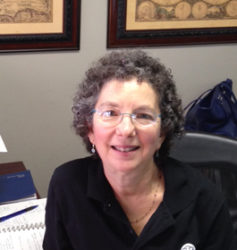
Me (Denise) at my desk at work. Notice the journal, to my left, and my MacBook Air (not visible, but just to the front of the notebook), where I am penning a book about my CLL experience.

Hello, It’s September 1st of 2017, and I thought I just might be overdue on making a post here. An update, if you will. I’m doing fine. Great, even. As a matter of fact I pay more attention to my signs of aging than I do my CLL, which is amazing! When I realign my psyche, I realize that I’m totally grateful to be living long enough to worry about wrinkles! Yay. I’m 62, and I have four grandchildren. When I first started this CLL Odyssey, I wasn’t at all certain I’d reach this stage or status. But I have. And the more I read and learn, the more I believe that it’s not a fluke. Others have done it, and I’m doing it, too.

WBCs and other markers. When I was first diagnosed in 2001, my WBC was a paltry 14.something and I was in Stage Zero. Of course I was still totally freaked out, and gearing up to die sometime soon. Despite all my efforts, my highest WBC was somewhere around 47, in 2012 or so. (I don’t have my Excel Chart with me.) Today, at last reading it was 17.something. Better yet, it’s been in the teens for about over a year. And my hemoglobin, which has dipped as low as the 10s, has been consistently normal, and over 12, for the same period of time.

My magic bullet? I don’t have a magic bullet. And I’m not cancer-free, either. If I went to the doc’s office for the first time and had a blood test, I’d be diagnosed. (I’m working on this, but not at all with the fear factor; I just work to be as well as possible, very consistently.) But back to the magic bullet. Over the years (since 2001), I’ve changed up and tweaked my diet several times. I eat zero processed foods, I buy and eat organic as much as possible. I slow cook all foods, vegetable and animal protein. This means I have soups and stews, and slow stir fries, which all happen to be delish! I eat no sugar or gluten, and the only dairy I eat is grass-fed butter. I’ve gotten rid of all toxic home care and personal care products. (This means I clean my house with baking soda, vinegar, and peroxide.) I exercise on an elliptical trainer, rebound, and lift weights 3-5 times/week. A big part of my daily/weekly diet is home-made fermented foods (sauerkraut and pickles) and bone broth soup. And I take a boatload of supplements, including my 9000 IU of vitamin D3 and four Peak Immune pills (by Daiwa) every day. I (try hard to) get to bed by 10 or 10:30 and get a good night’s sleep. And it is my goal to make my life as stress-free as reasonable and possible.

Okay, that’s my magic bullet. Or my magic ammunition. Sorry, I know it’s not an easy answer. But it works! It’s possible that if I tweaked just a bit more, I could get those numbers down to normal. But honestly, I’m pretty happy where I am. Watchful. Persistent and consistent. (I don’t cheat. Ever.) And despite all those changes, I feel like I live a pretty normal life. We enjoy our grandkids (and their parents), go out with friends, entertain. We even travel. Traveling is challenging, but worth it. We try to rent hotel rooms with kitchens, and bring enough food to make it comfortable. If it’s a weekend away, I just order a lot of salads in restaurants, and eat oatmeal for breakfast. But if it’s a week, and that’s the longest we ever go, we pack cooking equipment and containers to take food with us on bike trips, or wherever. It’s not normal like everyone else, but it works. It’s still fun. I guess it’s our “normal.”

A CLL Alternatives Book. I’ve decided to write a book. I know that the information in this web site is disjointed. I know I should spend more time on it. But despite all my best intentions, I normally do not. But I am a writer at heart. And I’ve started to pen a book that puts all of this information into perspective. And into chapters. This is not a money-making venture. I plan to have the book available as an ebook on Amazon for  $0.99 and I will sell the POD (print-on-demand) book at cost. (Whatever they charge me to put it together, that will be the charge.) So whoever needs the book can have it. Once again, the book is not necessarily a blue print for what exactly to do with a CLL diagnosis. Because we’re all different. But…it will be a blueprint for learning and testing until you find what it is that YOU need to do to be well. I’m sure there will be a lot of commonality in everyone’s approach. And keep in mind that conventional allopathic treatment (chemo, etc.) is also not one-size-fits all.

This will be a long process, but I’m making my commitment here. My husband also wants to post videos of interviews and cooking demonstrations. I think the cooking would be helpful. I unfortunately learned how to cook naturally after our boys became adults and flew the coop.

Two Book Recommendations. Before I leave, I have to recommend two books. By rights, they should each be a separate blog post, and eventually (no promises) they may be. Both books opened my eyes and made me see that what I’m doing makes sense. And my results also make sense, too. I will go into no more detail but to say, please read these books! If you can choose only one, choose the The Metabolic Approach to Cancer, as it is most instructive of how to fight cancer with nutrition/etc. However, if you or a loved one has a leukemia or cancer diagnosis of any kind, you deserve to read Tripping over the Truth: How the Metabolic Theory of Cancer is Overturning One of Medicine’s Most Entrenched Paradigms.

Please respond by post or shoot me an email. We’re all in this together!
To your good health! – Denise

Carob-Coconut Oil Bars for CLL

CarobBarsCLL
Carob Bars for CLL

I’ve been asked by a few of my CLL buddies to share some of the recipes I use in my daily life—in my quest for optimal health. One of the items I make at least each week, and eat nearly every single day are Carob-Coconut Bars. Coconut oil is a natural for anyone trying to improve their immune system. It fights nearly all pathogens (germs), including viruses, bacteria, and protozoa. There is documentation on youtube.com about its ability to improve Alzheimer disease, and perhaps prevent it.

The problem is that coconut oil is kind of tough to eat on its own. Personally, I’m not that fond of the coconut taste. But the good news is that the taste of carob is a bit stronger than the coconut flavor, and carob has its own natural sweetness, so no need to add any natural sweetener to make it palatable.  (I first tried making this with powdered chocolate, and found it was awful without sweetener.)

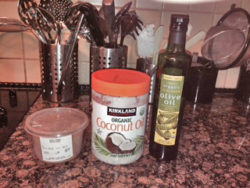
Ingredients for coconut oil carob bars.
Ingredients:

The ingredients are:

Coconut Oil (I buy organic from Costco)

Carob Powder (I buy from my local health food store)

Olive Oil (organic, cold-pressed from Trader Joe’s)


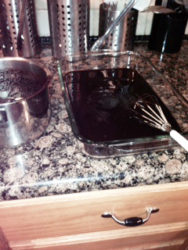
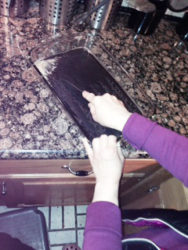
olive oil on lasagna pan
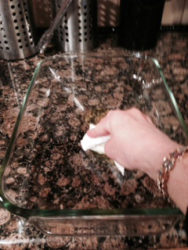
Olive Oil on lasagna pan.

Pour a tablespoon or so of the organic olive oil into a lasagna pan. This is so that the carob bars will be easier to remove from the pan when done.  I wasn’t specific about the quantity of each of the ingredients. This is because all you need to do is use equal amounts of coconut oil and carob powder. I buy carob in plastic containers at one of our local health-food markets. I wash them when empty and use them to measure the amount of coconut oil to use the next time. So, think 2 cups coconut oil to 2 cups carob powder. Simple!!!


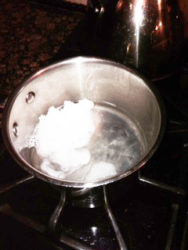
A tricky thing, though, is that coconut oil is a solid, unless it’s hot out and you don’t use air conditioning. 🙂   Because of this, you need to measure out the amount of coconut oil you need for your batch (figure 2 cups), and heat it on a low flame in a saucepan. It will melt quickly.

coconut oil in saucepan


When the mixture is totally blended, pour into your greased lasagna pan.

carob in lasagna pan
pour into lasagna pan


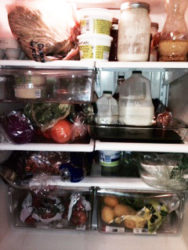
Put into the refrigerator to cool. (Its’ right in front of the milk.) (Notice all the veggies and fruit in my refrigerator.)

carob bars in refrigerator
Carob bar pan in refrigerator.


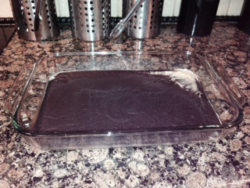
Carob Bars
Warming up a bit from the refrigerator.


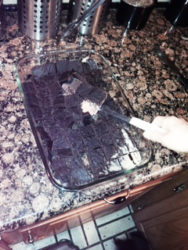
After at least an hour, remove from refrigerator and let return to closer to room temperature before cutting into squares.


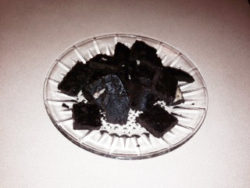
Carob squares
Cutting into squares.
Remove the square with a metal spatula.
Metal spatula removes squares.


I prefer to eat my carob bars cold, directly from the refrigerator. When I take them to work, I pack a freezer pack with it. It doesn’t taste as good warm…and the coconut oil gets mushy at room temperature.  That said, I’ve had regular civilians (company who are NOT into natural health!) enjoy these bars when served cold along with walnuts or almonds.

Options:
You could make them with chopped nuts inside. You could eat them frozen. (But be careful, I nearly chipped a tooth trying that; hubby has stronger teeth–no problem for him.)

Conclusion: These are a tasty, delicious dessert for those who have been dessert deprived (like me). I love them!!! I eat six to eight 1-inch bars each day. (They are about a quarter-inch thick. Sorry, I don’t know metrics, so please convert if you’re not from the US.) If you decide to give this a try, let me know what you think.

Wishing you healthy thoughts and life! – Denise


Alive and Well with CLL — 14.5 years now and counting…

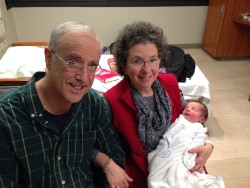
Me and Peter with brand new grandson.

I’ve been so busy with my life lately, that I’ve neglected posting here on my CLL web site. The good news is that I’m doing well! My numbers have been improving. I’m stable, and therefore have been able to concentrate on other things in my life: like my work and my grandkids. (Jared, pictured at left, is our fourth grandchild. When diagnosed in 2001, I didn’t know that I’d be blessed to live long enough to see our sons marry and have children.) However, sharing my CLL experience is so important to me. I’m doing well and it’s not by accident. It’s not “spontaneous,” even though that is how a conventional doctor might describe my condition. It might not be “spontaneous remission,” but instead “spontaneous improvement.”

There is so much I’ve done, and so many changes I’ve made, that it will take many, many posts to share everything there is that you can do to try and improve your health. I believe that a lot of what I’m doing would benefit anyone with any kind of cancer—not just blood cancers, and certainly not just CLL.

Unfortunately, there is no one-size-fits-all breakthrough. Not in the conventional medical world. And not in the alternative world. However, (this is a BIG however), the alternatives don’t hurt you. They may be more difficult and require more effort and commitment, but they will cause no harm.

Here is a quick laundry list of my changes:

1. I never eat burnt food or any food cooked at too high a temperature.

2. I stick mainly to organic food, whenever possible.

3. I eat out once or twice a week, tops. This means I take my lunch to work. (I don’t consider this a hardship anymore, but a pleasure.)

3. I ferment my own vegetables, and eat them at each meal, at least a little bit.

4. I drink filtered water and organic herbal tea (specifically raspberry leaf tea, as it doesn’t leach iron and I tend to be anemic).

5. I have a whole orange about 5X/week in my smoothie. By “whole,” I mean the peel and the pith (the white part). The pith contains d-limonene, which is anti-leukemic.

6. I drink a cup of home-made bone-broth soup nearly every day. Several sources have recommended bone broth for leukemia and other blood cancers and disorders.

7. I exercise 5X/week for 15 minutes. On an elliptical, a rebounder (trampoline) and with weights. I’m not an athlete, but still pretty fit for a 60-year old.

8. I get sleep at night!!! It feels wonderful. I shoot for going to bed at 10, and get into bed by 1030 or 11 each night. Since taking a new pill (for my hair, prescribed by an alternative doctor), I’ve been sleeping like a baby. Okay, I’ll amend that: I sleep like a baby without colic. : )

There is probably more, but I’m writing at the top of my head right now. Each of these eight items could be it’s own blog post. And I’ve been asked by my CLL-buddies who write to me to please post some recipes. And I will. I promise. It all takes time and I’m delighted to say that I have a busy (and pretty healthy!) life. But this matters to me. YOU matter to me. So I promise I will get on with it and keep posting.

If you’d like to be one of my CLL-buddies, please write me at cllalternatives @ gmail.com (with no spaces — those are for the mail-bots). And please feel free to post on this article and on this site, because the more we share, the more we help even more of us struggling with CLL.

Living Well with CLL — June 2015 Update

DenisePeterDogsSummer2014Living Well with CLL — June 2015 Update
It’s been just about fourteen years since I was first diagnosed with CLL, and I thought it was time I made an update. It’s always my goal to post more frequently. I worry that people who go to this site will get a flash of fear if I haven’t posted in months (or even in a year!). I know I used to worry that other CLL-ers might have become too ill to post — or worse. So I always resolve to post more frequently. One resolution I have made good on is that it’s now possible to make posts in the comments section of this site rather that to be available only via email. This is huge! The more we can communicate on this site, the more people can benefit from the information we put out here.

I would like to say that as much as I’ve started this site to help others, it has been helpful for me, too. So a big THANK YOU to all the people who have become my email buddies! We are all proving that CLL does not have to be a death sentence. We can survive with — and without — conventional treatment, depending on our needs and particular situation. Whether we choose to go conventional or not, all the good things we do for our health will help us stay well and prevail!

Now I feel like I’m writing a State of the Union address. But what I really want to do is give an update of my health. I’m doing very well! My last blood test was better than it had been in eight years! Perhaps I will soon post my personal Xcel sheet, showing my blood test results from June 2001 to the present. Now here comes the question: what have I been doing to be well and stay well (and even get a little better)?

I wish I could give you a magic-bullet answer. But the answer is simple and also complex. (sorry) If you look through this web site/blog you will see a lot of the things I’m doing and have done. But there are some basics and I will share them with you.

1. Get eight hours of sleep each night. We heal while sleeping, so why not get the most benefit out of this. You can go to mercola.com and look up suggestions to make this happen. What I personally do is eat a light dinner (most of the time), make certain your bedroom is super dark (room darkening blinds or drapes), take your magnesium before bed. Wind down and keep electronics out of your bedroom. (I do read my Kindle each night, but no TV.) I love this! It’s very luxurious to get enough sleep each night. I go to bed with the expectation of at least a half hour to read. After that I sleep well. Also, I try not to drink too much after dinner to avoid trips to the bathroom.

2. Reduce stress. Yes, life is worth living with less stress. Maybe even worth more than a high-stress life. Make subtle changes in your work life and in your personal life to accommodate this. Be kind to yourself. Imagine that you’re helping someone else, if that’s what it take to allow yourself to say ‘no’ to others’ demands. (This doesn’t mean you have to become self-centered; just that you don’t over-extend yourself to the point of making your life difficult.)

3. Eat food as close as possible to the way God made it. This means eating a lot of fresh, organic vegetables, either raw or lightly cooked — or better yet fermented. Learn how to ferment your own food. It’s easy once you get the hang of it. I can perhaps make some posts about how to do this. But honestly, youtube.com is loaded with videos of more talented people sharing their cooking and fermenting tips. I also eat organic beef, chicken, turkey, wild-caught salmon, some dairy (not much, still have some lactose intolerance), organic nuts and seeds (pre-soaked) and occasional bean and rice dishes. I soak all grains and legumes for several hours before draining, rinsing and cooking. This releases the phytic acids that protect the grains/beans from spoiling, but also make these foods hard to digest.

I’ve recently started to drink GT brand kombucha, which is a fermented tea — and it’s delicious! And also chock full of probiotics and a great way to detox. I’ve taken a class through my local Weston Price Foundation in how to make this drink at home. Can post about that as well, eventually.  The point is to take in as many natural probiotics in the fermented foods and drinks. This is much more effective that taking the probiotic pill. (Not that I’m against pills; I take a boatload daily.)

4. Never eat burnt or even browned foods. I know this is hard to deal with to start, but honestly I’ve learned how to make delicious foods even with slow-cooking only. I make soups and stews. When I roast chicken, I season and then add a lot of water to the roasting pan (about half-way up the raw chicken), and then cover the top of the pan with foil or the lid, and cook at 350 degrees for the usual amount of time (an hour to 1.5 hours), keeping an eye on the chicken to make certain it doesn’t get close to burning. The chicken comes out tasting great! Fall off the bone delicious. I cook enough for leftovers, so that I’m not cooking all the time. On nights when I don’t have time to cook (or haven’t planned ahead) I slow-fry farmer’s market eggs in grass-fed butter on my cast-iron skillet. I simmer all the way through, carefully turning over when the eggs are just done enough to turn. No brown–front or back — and delicious. You can also boil or poach your eggs, as this is easier! (just love those fried eggs) 🙂

5. I’m gluten free all the time. I’ve been doing this for so long it’s not a challenge. I just about never eat bread,but do keep gluten free bread in the freezer for emergencies. I’ve found that if I eat even the gluten free bread twice in one day I get mouth sores! This is a message from my body to stay away from processed foods!!! I will make that it’s own number:

6. Do NOT eat processed foods! It’s poison, even the organic so-called healthy stuff (see GF bread above). It’s okay on a rare occasion, particularly when you’re with other people. but try to avoid this on a regular basis.

7. Exercise regularly. Your body was meant to move. Exercise as much as you can and as often as you can. I’ve never been athletic, but even I can exercise. I rebound, sprint on the elliptical, and lift weights at least three times a week. Rebounding is bouncing on a mini-trampoline. This is great for CLL as it moves the fluid through your lymph system. If we’re sedentary, the lymph doesn’t drain, which is not good. So bounce several minutes a day at least. Gentle bouncing works as well as high bouncing (and doesn’t jar your body so much). Sprinting means I go as fast as I can 30 seconds out of every two minutes I’m on the elliptical. I don’t recommend the treadmill. It’s more boring (to me) and too many people have been injured on it. I’m thinking of a co-worker, Sonia, Harry Reid, and also the Facebook COO’s husband. No point in taking good care of yourself and then risking your life while exercising, no?

8. Choose your supplements wisely. I probably take too many. Supplements are like advertising. You take a lot of them and they work; but you’re not sure which ones are working! Here are two of my favorites: (not going to include my entire list, as some of them are to preserve my hair as I’m one of the 1/3 of women who experience hair thinning with age; also take a lot for natural thyroid care and heart health. Not all my issues are CLL-related).

A. Peak Immune (by Daiwa) ~ has been a life saver, possibly literally, in keeping my neutrophils at an acceptable level. I’ve actually inadvertently done a double-blind on myself with this pill. When I take it, my levels are good. When I stop, after a few weeks or months, down they go. If your neutrophil level is fine, don’t bother with this pill as it is expensive.

B. Vitamin D3 ~In recent years, this vitamin has been shown to be a potent anti-cancer product. See this vitamin D3 article. Is my good health due to the fact that I’ve been taking 8,000 to 10,000 IU/day, in divided doses for years now? The point is to keep your level, measured in the vitamin D hydroxy test at 70 – 100 for cancer control.  My level varies between 79 and 102. (Nothing bad happened when I slipped above 100; I just reduce the dosage for a while.)

9. Get at least 15 minutes of natural sunshine in the peak time of the day during the summer months, despite what your dermatologist might say. Just don’t burn!!! Otherwise you are gathering up natural vitamin D the way Mother Nature intended.

10. Bone Broth Soup. (Okay, this is out of order here, but bear with me.) Boil beef bones and chicken soup bones (with and without meat) simmering for 24 – 48 hours. Store in freezer in portioned jars. The soup  should gel when refrigerated. This will provide cancer-fighting nutrients. There is a whole book on this subject by Sally Fallon of the Weston Price Foundation.  Go to their web site for more info: Weston Price Foundation.

11. Coconut Oil and other Fats. After all these years of being told to eat less fat, it turns out these saturated (and other) fats are healthy! You’re supposed to eat at least three tablespoons of organic, UNrefined coconut oil/day, possibly six tbsp/day — all in divided doses to keep the level in your body even. Coconut oil is an anti-pathogen, meaning that it kills bacteria and other germs. This supports your immune system in its fight against the CLL cells. More of your immune system is available. Butter (not margarine, which is a fake, synthetic food) is also healthy and if recommended for every day use. Take care not to overdo. I LOVE coconut oil mixed with toasted carob powder, and tend to overeat this, which tends to make me put on weight… so watch your quantity. You can get too much of a good thing.

12. Alkalize.  Every morning I have a 16-oz glass of filtered water with 2 tbsp ACV (apple cider vinegar) and 1 tbsp organic lemon (my husband juices the entire lemon to make use of the d-limonene in the peel, which is also supposed to be anti-cancer, but you don’t have to do that, of course). At bedtime I have a 12-oz glass of filtered water with 1/4 to 1/3 teaspoon baking soda. These drinks help keep my PH at about 7, which is desirable for preventing and treating cancer. The other good news, you are pre-, post-, or just plain menopausal, is that, at least for me, the baking soda before bed has eliminated hormonal night sweats. Yay! Easier to sleep. Measure your PH level with strips you can buy online or at your local healthfood store. My favorite online supplement/health item source is iherb.com. Very reliable and reasonably priced. (Please note that I am not an affiliate; this is an absolutely NOT for profit site.)

13. Blood test regularly. I really don’t like going to the doctor. I really don’t, especially not to the hematologist where I get to see people getting chemo, and a lot of sick-looking people in the waiting room. It is demoralizing! So what I do is I pay out of pocket for blood tests between visits (which are getting farther and farther apart). I go to Direct Labs and order a CBC and whatever else I think I need. (I have anemia and thyroid issues — and hair issues — as well as CLL.) You place your order online. It lets you know what location(s) local labs are available. You print out your order (requisition is emailed to you), take it to the lab, get the test, and in 24- 48 hours, most test results are available. In my case, my co-pays and deductibles are so high these days that it makes sense to pay out of pocket. If I became concerned, I would go to the doctor. (Just saying.) But in my case it’s been a great way to keep score and get an idea of what’s working and what isn’t. I also mail a copy of the results to my hematologist so we can be literally on the same page.

I guess I will end at Lucky 13. Please post comments on this and other pages, and I promise to get back to you. If you’d like a more personal communication, I can be emailed at cllalternatives @ gmail.com (no spaces). Wishing you good health and peace! – Denise


Liposomal Vitamin C and CLL

Chronic lymphocytic leukemia and lyposomal vitamin C.
Lyposomal Vitamin C and CLL — Works for Some

Question:
Have you heard of vitamin C treatment for CLL?

Answer:
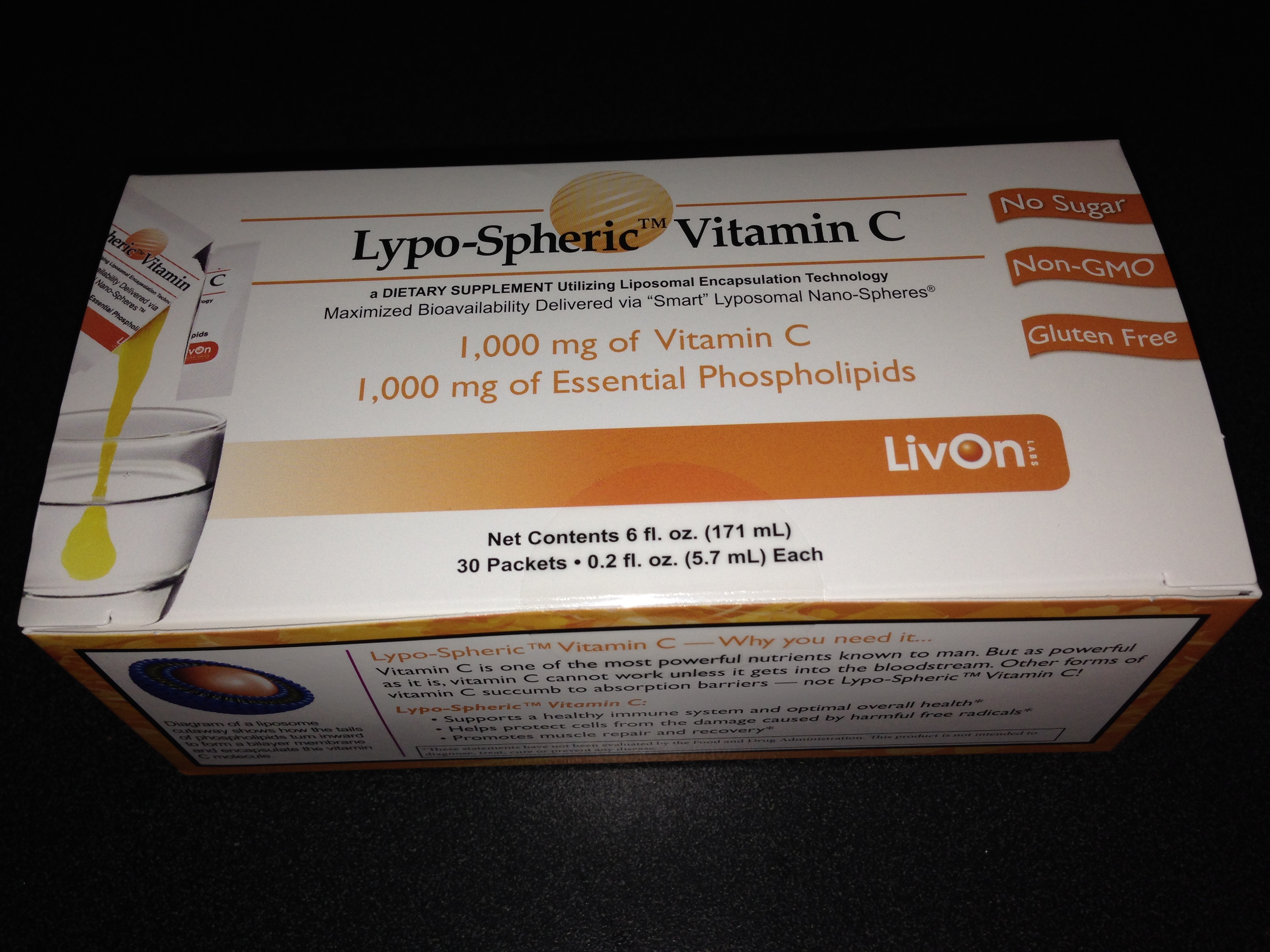
I have suggestions for you as I’ve recently come across another product that just might help you. It’s liposomal vitamin C. So far, I’ve just started it myself and have no data to share with you as yet (although I have “herxed”with bone and joint pain, ironically encouraging : )   I’ve been intending to post about it, but I think I’ve been waiting till I have my own results.  But here is why I’m encouraged:

One farmer in New Zealand had H1N1 AND HCL (hairy cell leukemia). He was treated in the hospital with vitamin C IV and this saved him death (they’d been ready to pull him off life support). After the IVs became less available, he started taking the liposomal C.  Not only did he fully recover from the H1N1, he now has zero sign of the HCL. Here is the video about this man and his story:(the first is a full version, the second link is to a shortened version)

 A new practitioner I started seeing late last year has suggested that I take liposomal Vit C.  She suggested taking 1 packet for 3 days, and then to work myself up to 15 packets a day and hold for two weeks. I think that may be too many.  I may top out at 5 or 6.  While I was ruminating on this, I received an email, like yours, from a man asking about LDN for his father who has CLL.  This man told me that his father was doing pretty well taking Life Force green drink and liposomal C.  Okay, I now felt like I was getting messages from the universe. : )

So I communicated with Todd who later told me that his father’s WBC dropped from 70 (70,000) to 9 (9,000) from the protocol of the Life Force and the Liposomal C.  Now there are two people with a chronic leukemia who’ve benefited from liposomal C.  So I’ve started this protocol for myself.  Here is a link to the company that makes this product.

CLL Low Neutrophils ~ An Alternative that Works!

peakimmune1

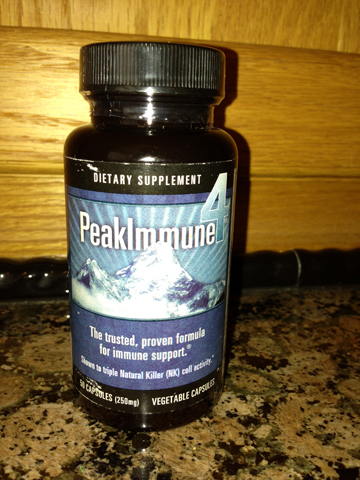
I’ve been using Peak Immune off and on now since 2011 and I have to tell you that it works! Yes, I still carry the CLL diagnosis, but… if your neutrophils dip into dangerous territory, which mine do without the help of Peak Immune, then you are a prime case for starting conventional therapy. A low neutrophil count can be fatal.  So this is a very important blood marker.  In some ways, it’s like I’ve done a double blind on myself. What happened is this:

In May 2011 my hematologist told me that my neutrophils were dangerously low, at just about the .5 mark. The normal range for neutrophils is 1.96 – 9.72. We’re talking the ‘absolute’ neutrophil count, not the percentage. Don’t worry about the percentage! If you have a CLL diagnosis, that number will be well below normal and you can be functioning just fine. My hematologist (who I like) wanted me to try Rituxan, and some Neupogen. She knows that I’m a researcher, so we decided to wait for the next visit. At the first revisit, the count had gone back up on its own. At the two-month revisit I hadn’t taken anything as yet, and the neutrophil count dropped dangerously low–down to .59.

My doctor was genuinely worried about me. A person with a very low neutrophil count is susceptible to disease and illness and has little to fight it off. However, I was NOT interested in either of her choices. Rituxan is a monoclonal antibody that has worked in conjunction with chemo. I saw it as a gateway drug to hell. Neupogen is NOT a chemo. However, it is a drug for life, as once you take it, your body stops producing its own neutrophils and you become dependent upon it. Add to that that Neupogen is self-injected into the abdomen, and I was thinking—and saying—“no thank you!”

So back in 2011, at this time I took the Peak Immune product, as it was recommended by a Chinese herbalist, and because on the bottle it says that these pills increases NK (natural killer) cell activity. I thought that would have to be good enough and it was definitely worth a try. But it turns out that Peak Immune increased my neutrophil count. At the next blood test, my absolute neutrophil numbers went out of the danger territory and my percentage went up as well. After I finished a bottle or two, I figured that I was out of the woods and didn’t need the product any longer. After all, I was taking UBI (ultra-violet blood irradiation treatments) and keeping up with an extraordinarily healthy diet and lifestyle.

I did pretty well with my neutrophils after that, taking regular blood tests to keep track. However, in February of 2013 the count was right back down to .51. I panicked. I hadn’t given the Peak Immune the credit it deserved for keeping up the neutrophil count. But for some reason, I looked it up on iherb.com to see if anyone else had mentioned neutrophil counts in the reviews. There was only one review and it was very positive on this very subject! I was so excited. I thought it sounded familiar and I saw that the reviewer was from Michigan. Then in a complete airhead moment, I realized that that one reviewer was me! I had given credit to Peak Immune for helping with my neutrophil count, and posted it online. But I had forgotten this for myself!

Needless to say, I’ve been taking this product ever since, and thankfully my neutrophil count is in the safe target zone still. This is obviously not a cure, but it is a health and life-preserver. I give this pill my ultimate personal endorsement. And please keep in mind that I sell absolutely nothing on this site and get nothing from any company. Feel free to comparison shop on amazon and any other outlet.

Oh, and please write and let me know if it works for you!

Another CLL Success Story!

I apologize for not posting more often. Now and again I get emails asking if I’m still here–as in alive. Yes! I’m very much alive and relatively well. By relatively, I mostly mean my parents, both of whom are geriatric (82 and 87) and both of whom are ill (congestive heart failure and stroke) and are more time-consuming than I’d like. Between that and part-time work, and an occasional foray into writing my second mystery book, I just don’t make time for this blog.  This is a GOOD reason to be offline, however, compared to what other CLL-ers imagine.

But enough of the introduction. I’m writing because one of you (by “you” I mean one of the many CLL-ers who have contacted me via email) sent me this link: David Lingle’s CLL Healing Story

And here is the video itself:

This is very exciting! Every success story is exciting. It means that it is possible to beat this thing naturally. However…keep in mind that not everyone heals the same way. This is true when the conventional doctors give chemo (some will go into remission, some will not, some will die from the treatment), as it is with natural treatments. The only difference is that with natural treatment, it may not cure you, but it will probably make you healthier.

As I listened to the video, I noted that David Lingle, the man who is now CLL-free, is mostly vegan. Don’t think I want to do that again. It wasn’t so good for me.  When I was macrobiotic for many years I developed both osteoporosis AND anemia. I am now a raw food enthusiast…AND I include slow-cooked organic animal protein as well. I’m not cured. However, I’m doing relatively well. (I’m always as good as my last blood test. It isn’t easy, but most of the time I try to stick to my program and ignore an upcoming blood test. It’s better on the psyche.)

Even if I don’t plan on following this man’s whole program, I’m encouraged to see that he uses an infrared sauna. I’ve been considering that for a long time. I’ve heard from several of you that this helps. Please watch this and see whether this provides hope, inspiration and practical suggestions for your own recovery and good health.